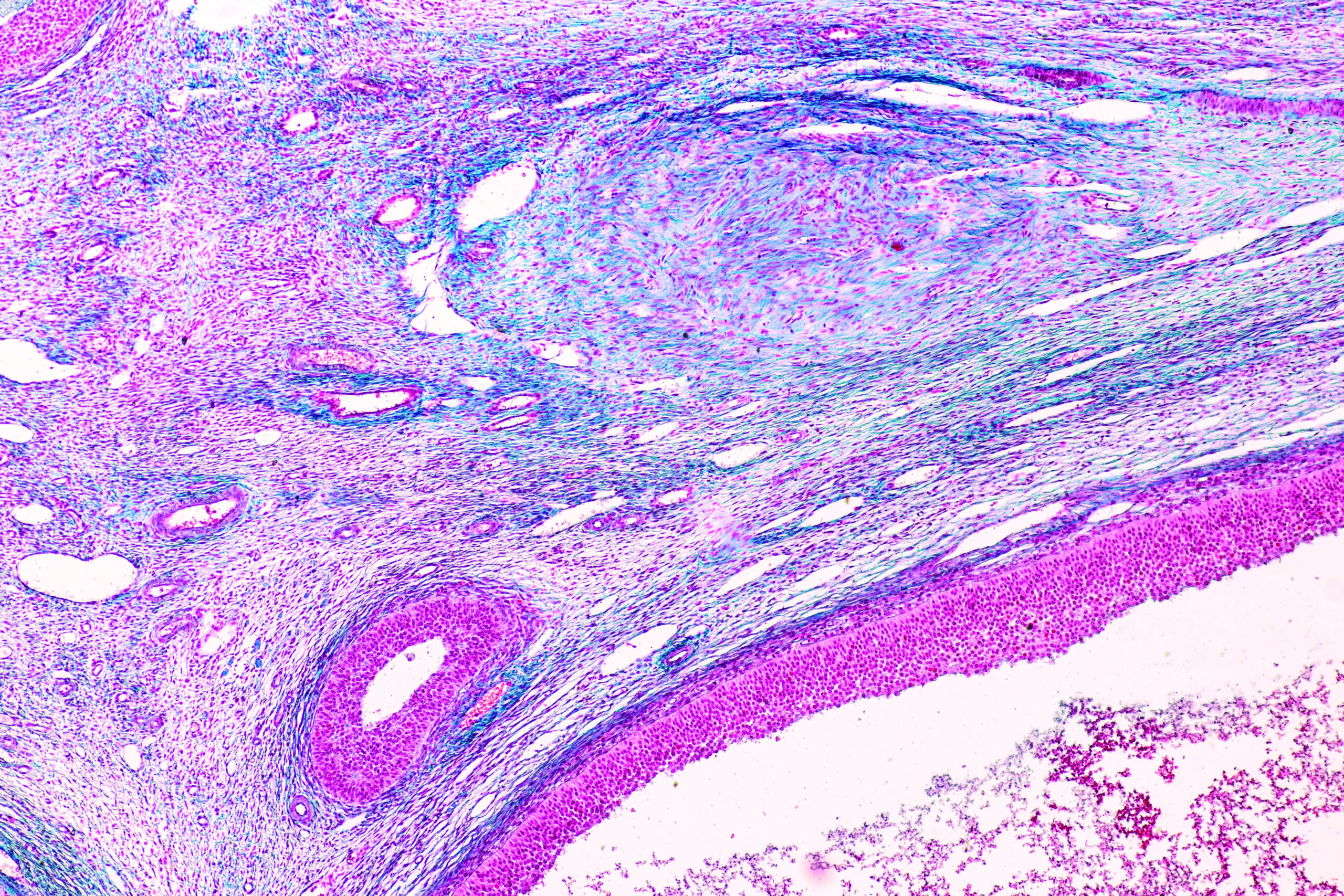
Understand how ovarian cancer becomes resistant, not just whether it responds
Use longitudinal patient-derived and drug-selected ovarian cancer resistance models, alongside additional models, to understand how resistance develops, what defined treatment pressure selects, and whether the resulting biology holds across different molecular and disease settings.
How you model resistance determines what you can learn
Drug-selected and longitudinal patient-derived models provide different evidence about resistance. Drug-selected models isolate adaptation under defined treatment pressure, while longitudinal models capture resistant states that emerged during patient treatment and relapse. Used together, they provide complementary evidence for investigating how resistance develops and persists.
| Comparison point | Drug-selected resistance models | Longitudinal patient-derived models |
|---|---|---|
| Selection context | Defined drug pressure in vitro | Disease sampled across treatment and relapse |
| What they help reveal | Drug-selected adaptation | Change across treatment trajectory |
| Experimental advantage | Greater control over selection pressure | Captures disease states shaped by patient treatment history |
| What remains harder to resolve | Whether findings reflect patient-evolved resistance | Which changes are associated with treatment |
Three ways to investigate how resistance develops and persists
Follow treatment-associated change, dissect adaptation under defined drug pressure, and test whether findings hold across additional ovarian cancer models.
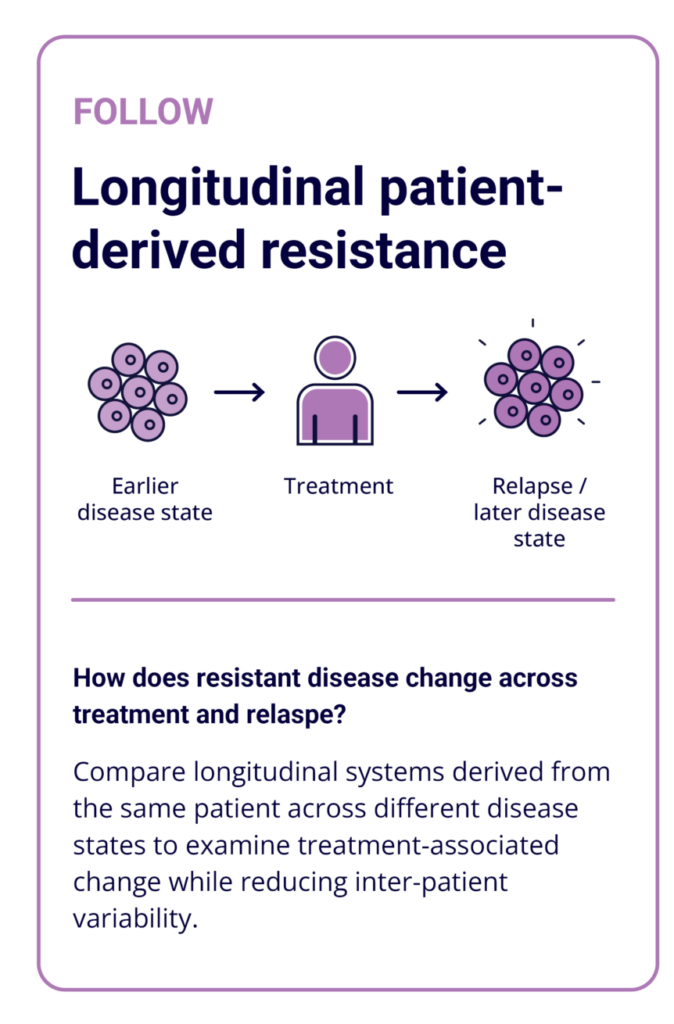 | 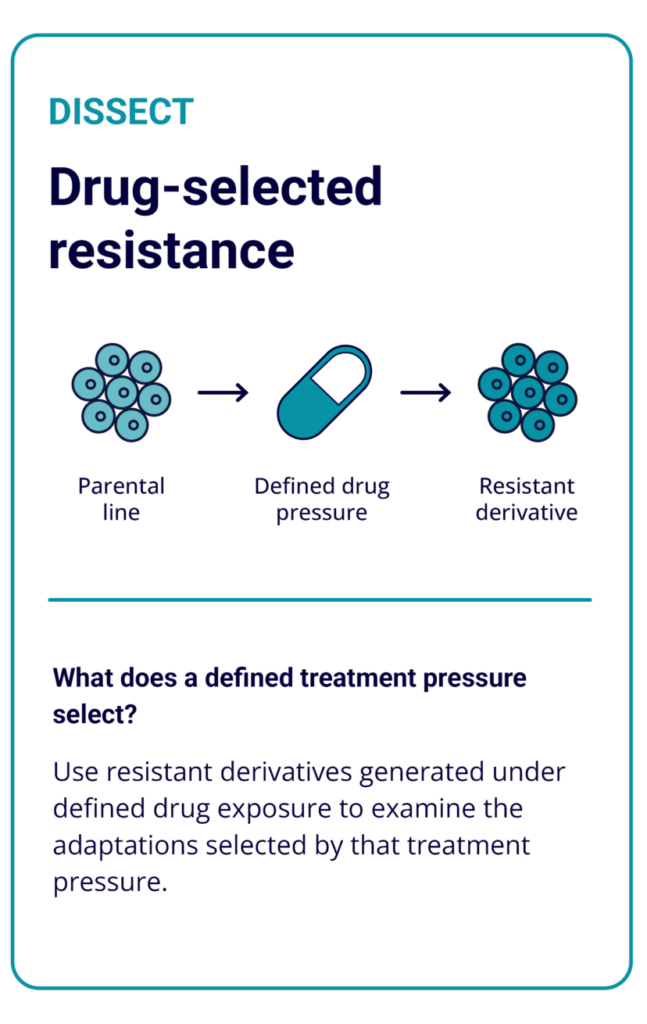 | 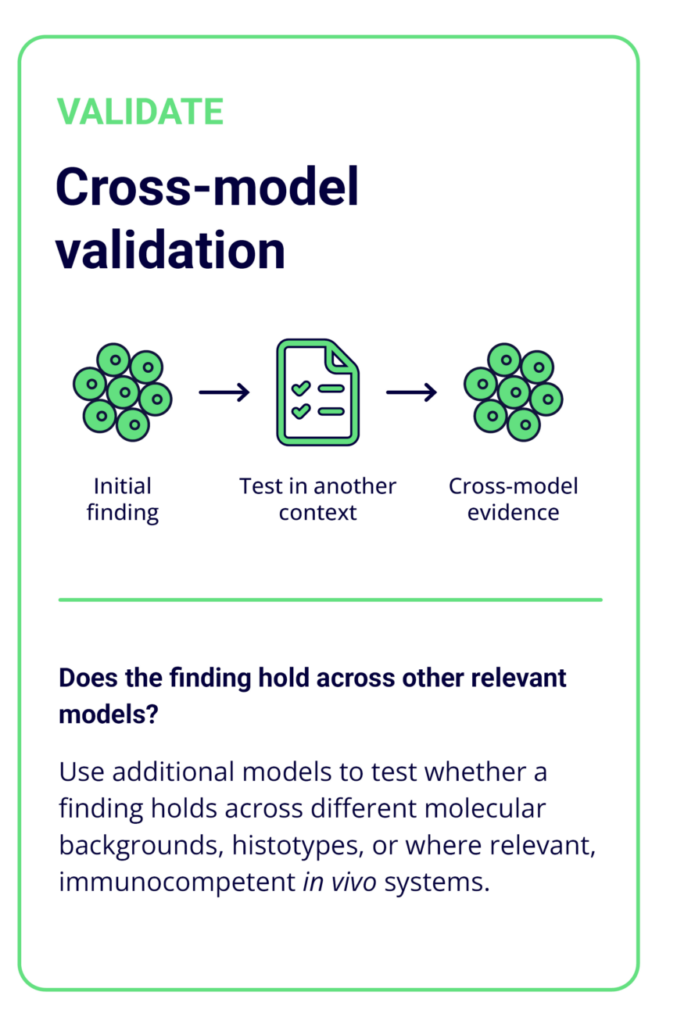 |
| FOLLOW – Featured models: PEO longitudinal models OV/TOV treatment-evolution models | DISSECT – Featured models: Platinum-selected HGSOC models PEO1 drug-resistant derivatives A2780 resistance models NCI/ADR-RES multidrug resistance model | VALIDATE – Featured models: OV/TOV cross-context validation models HGS1-4 immunocompetent models |
Using both drug-selected and longitudinal patient-derived models helps distinguish adaptations selected under defined treatment pressure from resistant states that emerged through patient treatment. Matched models can help reduce inter-patient background differences, while additional models test whether the finding holds across different molecular settings, histotypes or in vivo systems.
Explore models for different resistance questions
How does resistance that emerges during patient treatment compare with resistance selected under defined drug pressure?
PEO1, PEO4 and PEO6 were derived from the same patient at different treatment stages, enabling direct comparison across treatment and relapse. The PEO system also includes PEO1-CDDP and PEO1-OR selected for resistance to cisplatin and olaparib respectively, allowing clinically evolved resistance to be compared with resistance selected in the laboratory.
Which treatment-associated changes are patient-specific, and which may recur across different disease trajectories?
Matched OV/TOV series derived from the same patient across diagnosis, treatment and relapse enable comparison of disease states over time while reducing inter-patient variability. Using multiple longitudinal HGSOC series helps assess whether observed changes are specific to one patient or seen more broadly.
Featured longitudinal series
- 3133 series: TOV3133D | TOV-3133G | OV-3133(R) | OV-3133(R2)
- 2295 series: OV-2295 | TOV-2295(R) | OV-2295(R2)
- 1369 series: TOV-1369TR | OV-1369(R2)
Which adaptations are selected by platinum exposure, and which recur across different HGSOC backgrounds?
Platinum-resistant derivatives of OVCAR4, Ovsaho and Cov318 provide defined systems for examining adaptations selected by cisplatin or carboplatin. Comparing them across different HGSOC backgrounds can help distinguish recurrent responses from model-specific effects.
Featured models
- OVCAR4 derivatives: OV4Cis (cisplatin) | OV4Carbo (carboplatin)
- Ovsaho derivatives: OvsahoCis (cisplatin) | OvsahoCarbo (carboplatin)
- Cov318 derivative: CovCis (cisplatin)
- IVRO1: OVCAR4-derived, carboplatin-resistant model selected in vivo.
How do resistant states differ across established drug-selected reference models?
A2780 and its resistant derivatives provide established systems for comparing drug-sensitive and resistant states selected by cisplatin, adriamycin or stepwise paclitaxel exposure. A2780 is best used as a widely recognised ovarian cancer reference model rather than as a representative model of HGSOC biology.
Featured models: Parental A2780 | A2780cis (cisplatin) | A2780ADR (adriamycin) | A2780 PTX series
How can broad multidrug resistance and drug efflux be modelled?
NCI/ADR-RES is a multidrug-resistant ovarian cancer cell line derived from OVCAR-8 and selected for resistance to doxorubicin. It expresses high levels of MDR1/P-glycoprotein and is widely used to study drug-efflux-mediated resistance and strategies designed to overcome broad chemoresistance. As part of the NCI-60 panel, it also provides a well-established reference model for comparative drug-response studies.
Featured model: NCI/ADR-RES
Does your finding hold across different molecular backgrounds, tumour sources or histotypes?
Additional OV/TOV models span different BRCA backgrounds, matched tumour and ascites samples, and multiple ovarian cancer histotypes, helping distinguish model-specific findings from those that may be seen more broadly.
Featured models
Does your finding hold in an immunocompetent HGSOC setting?
Need help choosing the right ovarian cancer model?
Our team can help you select ovarian cancer cell lines and other models, check availability, and discuss commercial access and licensing options.
Scientific or model-selection questions?