Anti-p53 [DO-12]
Understanding the functions of mutant p53 can help in the development of new therapeutic approaches that may be useful in a broad range of cancer types.
Contributors
| Inventor | Institute |
|---|---|
| David Lane | University of Dundee |
| Cat. #: | 153403 |
|---|---|
| Tool sub type: | Primary antibody |
| Unit size: | 100 ug |
| Research Fields: | Apoptosis and autophagy;Cancer;Cell biology;Immunology |
| Application: | IF ; WB |
| Target: | Human TP53 / p53 |
| Reactivity: | Human |
| Clone: | DO-12 |
| Host: | Mouse |
| Class: | Monoclonal |
| Alternate name: | p53 |
|---|---|
| Product description: | Anti-p53 DO-12 antibody recognises the human cellular tumour antigen p53, also known as p53 tumour suppressor protein or NY-CO-13. p53 is a 393 amino acid ~53kDa cytoplasmic/ nuclear protein upregulated in response to DNA damage and is found in a wide variety of transformed cells. DO-12 is directed to an epitope in the DNA binding region of p53, between amino acids 250-270. It is believed that twelve isoforms of human p53 are produced by alternative splicing and promotor usage; the epitope recognized by clone DO-12 is reportedly present in all isoforms. DO-12 recognises mutant and unfolded p53. |
| Conjugation: | Unconjugated |
| Isotype: | IgG1 |
| Molecular weight: | 53 kDa |
| Immunogen: | Recombinant human p53 |
| Immunogen Uniprot ID: | P04637 |
| Target background: | p53 is a crucial tumour suppressor involved in over 50% of cancers. It acts as a stress-responsive transcription factor and plays a vital role in regulating cell cycle arrest, promoting apoptosis, maintaining genomic stability, controlling the cell cycle, and inhibiting angiogenesis. Known as the "guardian of the genome," p53 prevents gene mutations. Mutations in the p53 gene are common in human cancers, resulting in dysfunctional proteins unable to bind to DNA. This loss of func… |
|---|
| Format: | Liquid |
|---|---|
| Concentration: | 1 mg/ml |
| Storage buffer: | PBS with 0.02% azide |
| Storage conditions: | Store at -20° C frozen. Avoid repeated freeze / thaw cycles |
| Shipping conditions: | Dry ice |
| References: |
Pang et al. 2013. Vet J. 196(3):414-23. PMID: 23219486. Fujita et al. 2009. Nat Cell Biol. 11(9):1135-42. PMID: 19701195. Bourdon et al. 2005. Genes Dev. 19(18):2122-37. PMID: 16131611. Vojtesek et al. 1995. Oncogene. 10(2):389-93. PMID: 7530828. |
|---|
Images
View Gallery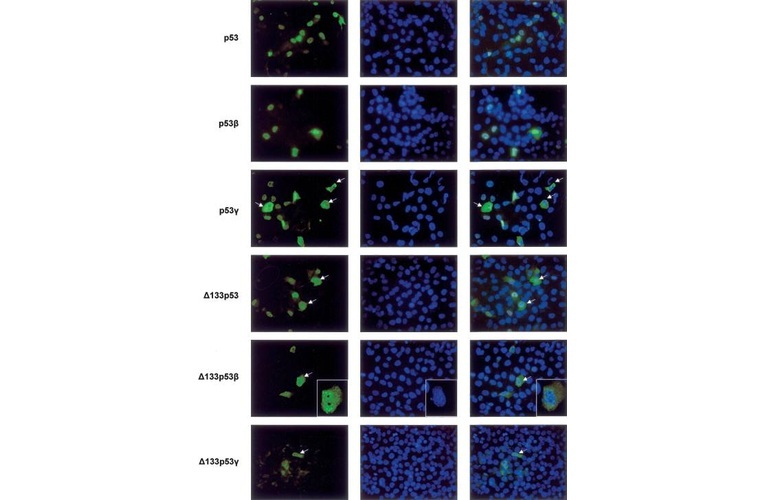
Product Images
15340320765×500.jpg
Related Tools for Antibodies
| Cat. # | Tool Name | |||||||||||||||||||||
|---|---|---|---|---|---|---|---|---|---|---|---|---|---|---|---|---|---|---|---|---|---|---|
| 151033 | Anti-HSVUL42 [13C9] |
Key Info
Anti-HSVUL42 [13C9]
|
View Tool | |||||||||||||||||||
| 151034 | Anti-HSVUL42 [13D11] |
Key Info
Anti-HSVUL42 [13D11]
|
View Tool | |||||||||||||||||||
| 151039 | Anti-Integrin aVb3 [23C6] |
Key Info
Anti-Integrin aVb3 [23C6]
|
View Tool | |||||||||||||||||||
| 151017 | Anti-MBP [R29.6] |
Key Info
Anti-MBP [R29.6]
|
View Tool | |||||||||||||||||||
| 151035 | Anti-CD8 [14] mAb |
Key Info
Anti-CD8 [14] mAb
|
View Tool | |||||||||||||||||||