Anti-Cytochrome P450 7B1 [M17-P3F2]
Defects in CYP7B1 are the cause of spastic paraplegia autosomal recessive type 5A (SPG5A) [MIM:270800].
Contributors
| Inventor | Institute |
|---|---|
| Ayham Alnabulsi | Vertebrate Antibodies Limited |
| Cat. #: | 152117 |
|---|---|
| Tool sub type: | Primary antibody |
| Unit size: | 100 ug |
| Research Fields: | Cancer;Cell signaling and signal transduction;Metabolism;Neurobiology;Tissue-specific biology |
| Application: | ELISA ; IHC ; WB |
| Target: | Cytochrome P450, family 7, subfamily B, polypeptide 1 (CYP7B1) |
| Reactivity: | Human |
| Clone: | M17-P3F2 |
| Host: | Mouse |
| Class: | Monoclonal |
| Product description: | Defects in CYP7B1 are the cause of spastic paraplegia autosomal recessive type 5A (SPG5A) [MIM:270800]. Spastic paraplegia is a neurodegenerative disorder characterized by a slow, gradual, progressive weakness and spasticity of the lower limbs. Rate of progression and the severity of symptoms are quite variable. Initial symptoms may include difficulty with balance, weakness and stiffness in the legs, muscle spasms, and dragging the toes when walking. In some forms of the disorder, bladder symptoms (such as incontinence) may appear, or the weakness and stiffness may spread to other parts of the body. Defects in CYP7B1 are the cause of congenital bile acid synthesis defect type 3 (CBAS3) [MIM:613812]. Clinical features include severe cholestasis, cirrhosis and liver synthetic failure. Hepatic microsomal oxysterol 7-alpha-hydroxylase activity is undetectable. |
|---|---|
| Conjugation: | Unconjugated |
| Isotype: | IgG1 lambda |
| Immunogen: | Ovalbumin-conjugated synthetic peptide IQYPDSDVL (C-terminal sequence) |
| Myeloma used: | P3X63Ag8.653 |
| Target background: | Defects in CYP7B1 are the cause of spastic paraplegia autosomal recessive type 5A (SPG5A) [MIM:270800]. Spastic paraplegia is a neurodegenerative disorder characterized by a slow, gradual, progressive weakness and spasticity of the lower limbs. Rate of progression and the severity of symptoms are quite variable. Initial symptoms may include difficulty with balance, weakness and stiffness in the legs, muscle spasms, and dragging the toes when walking. In some forms of the disorder, bladder symptoms (such as incontinence) may appear, or the weakness and stiffness may spread to other parts of the body. Defects in CYP7B1 are the cause of congenital bile acid synthesis defect type 3 (CBAS3) [MIM:613812]. Clinical features include severe cholestasis, cirrhosis and liver synthetic failure. Hepatic microsomal oxysterol 7-alpha-hydroxylase activity is undetectable. |
|---|
| Format: | Liquid |
|---|---|
| Concentration: | 1 mg/ml |
| Storage buffer: | PBS with 0.02% azide |
| Storage conditions: | -15° C to -25° C |
| Shipping conditions: | Dry ice |
| References: |
Characterisation of the oxysterol metabolising enzyme pathway in mismatch repair proficient and deficient colorectal cancer. Swan et al. 2016. Oncotarget. :. PMID: 27341022. |
|---|
Images
View Gallery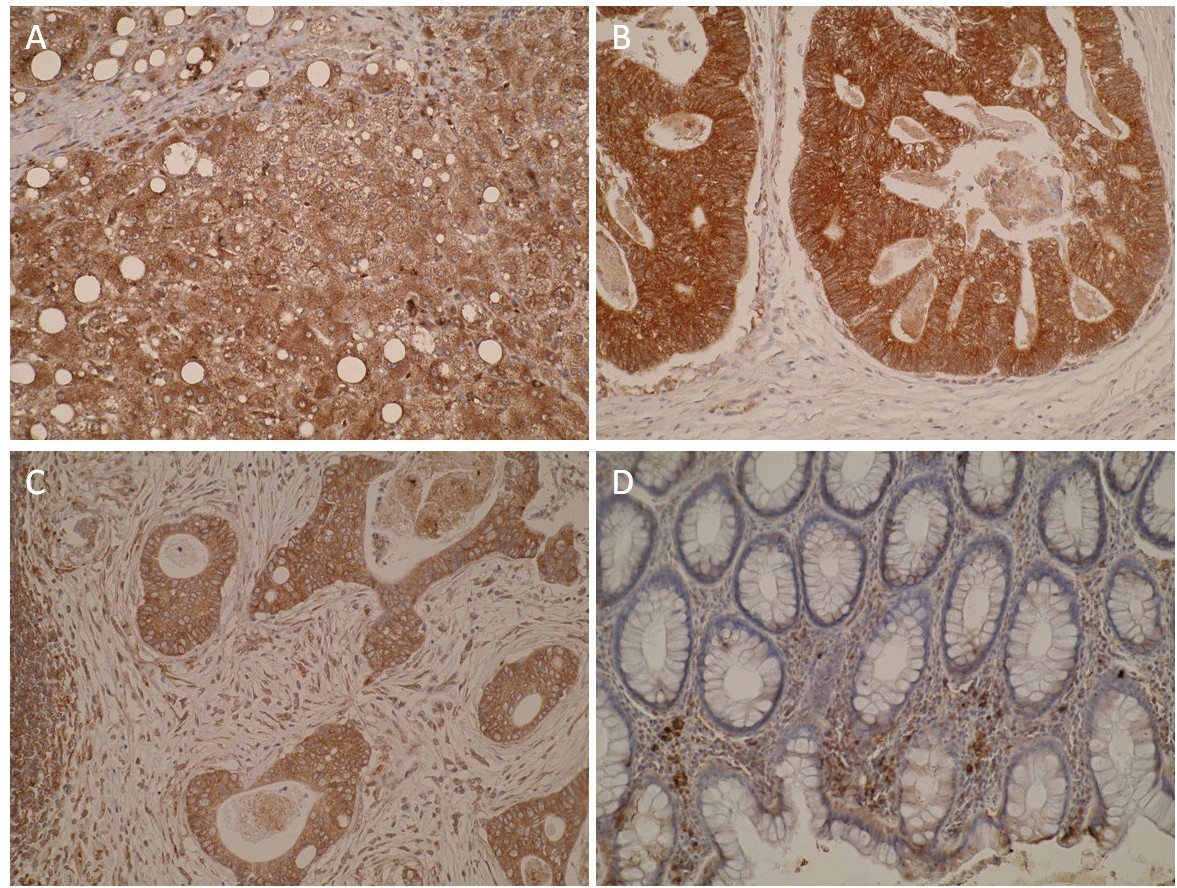
Product Images
6877fc3b-6d50-41de-abb0-f3ad76ede323.jpg
Immunohistochemistry was performed on formalin-fixed; paraffin-embedded tissue sections and showed positive cytoplasmic immunostaining in normal liver (A) which is expected as CYP7B1 is involved in bile acid synthesis. Primary colorectal (B) and metastatic colorectal tumors (C) showed stronger staining compared to normal colon mucosa (D).
Related Tools for Antibodies
| Cat. # | Tool Name | |||||||||||||||||||||
|---|---|---|---|---|---|---|---|---|---|---|---|---|---|---|---|---|---|---|---|---|---|---|
| 151030 | Anti-Progesterone [11P14] |
Key Info
Anti-Progesterone [11P14]
|
View Tool | |||||||||||||||||||
| 151021 | Anti-CyclinB1 [V152] |
Key Info
Anti-CyclinB1 [V152]
|
View Tool | |||||||||||||||||||
| 151033 | Anti-HSVUL42 [13C9] |
Key Info
Anti-HSVUL42 [13C9]
|
View Tool | |||||||||||||||||||
| 151020 | Anti-CyclinB1 [V143.1] |
Key Info
Anti-CyclinB1 [V143.1]
|
View Tool | |||||||||||||||||||
| 151038 | Anti-Cytochrome P450 4A2, 4A3 [Clo4] |
Key Info
Anti-Cytochrome P450 4A2, 4A3 [Clo4]
|
View Tool | |||||||||||||||||||