Msh3-/- SVG-A Cell Line
The MSH3 gene encodes a DNA mismatch repair protein important in certain cancer types and in certain neurodegenerative diseases.
Contributors
| Inventor | Institute |
|---|---|
| Robert Lahue | National University of Ireland Galway ; Brown University |
| SKU: | 153562 |
|---|---|
| Product description: | The MSH3 gene encodes a DNA mismatch repair protein important in certain cancer types and in certain neurodegenerative diseases.Exon 2 of the MSH3 gene was targeted by CRISPR/Cas9. The resulting Msh3-/- cell line encodes a 3 amino acid deletion in Msh3 that results in 98% loss of Msh3 protein, as judged by western blots with two different antibodies.While ~98% of Msh3 protein is lost in these cells, the abundance of the related proteins Msh2 and Msh6 appear unaffected. This is relevant to DNA mismatch repair. |
| Alternate name: | DNA mismatch repair protein Msh3, hMSH3, Divergent upstream protein, DUP, Mismatch repair protein 1, MRP1 |
| Conditional: | No |
| Production details: | Exon 2 of the MSH3 gene was targeted by CRISPR/Cas9. The resulting Msh3-/- cell line encodes a 3 amino acid deletion in Msh3 that results in 98% loss of Msh3 protein, as judged by western blots with two different antibodies. |
| Additional notes: | CRISPR edited cells. Cancer Research Technology Limited (trading research tools as Ximbio) has been granted a non-exclusive license to the CRISPR-Cas9 technology by ERS Genomics Ltd under the patent rights listed here. This license from ERS Genomics Ltd allows Ximbio to develop and commercialise CRISPR-Cas9 modified cell lines for research use only. Ximbio can provide the… |
| Parental cell line: | SVG-A immortalized human astrocytes |
| Disease: | Neurodegenerative diseases |
| Related tools: | SVG-A Cell Line ; SVG-A Msh3 1.7X Cell Line |
| Cat. #: | 153562 |
|---|---|
| Tool sub type: | Continuous |
| Unit size: | 1×10^6 cells / vial |
| Research Fields: | Cancer; Cell biology; Genetics |
| Organism: | Human |
| Tissue: | Brain |
| Model: | Knock-Out |
| Growth properties: | Adherent cell line |
| Format: | Frozen |
|---|---|
| Storage conditions: | Liquid Nitrogen |
| Shipping conditions: | Dry ice |
| Growth medium: | DMEM supplemented with 10% FBS |
| Recommended controls: | SVG-A Cell Line, SVG-A Msh3 1.7X Cell Line (derived from Msh3-/- SVG-A Cell Line) |
| Mycoplasma free: | Yes |
| Biosafety level: | 1 |
| References: |
Keogh et al. 2017. Nucleic Acids Res. 45(17):10068-10078. PMID: 28973443. MutS? abundance and Msh3 ATP hydrolysis activity are important drivers of CTGCAG repeat expansions. |
|---|
Images
View Gallery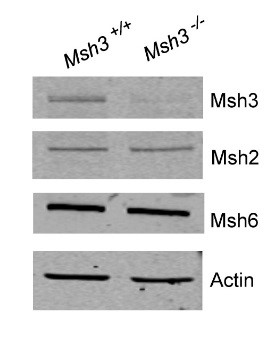
Product Images
Western blot comparison of Msh3-/- SVG-A cell line and parent unmutated SVG-A cell line (Msh3+/+). While ~98% of Msh3 protein is lost in the Msh3-/- cells; the abundance of the related proteins Msh2 and Msh6 appear unaffected. This is relevant to DNA mismatch repair. Reference
Related Tools for Cell lines
| Cat. # | Tool Name | |||||||||||
|---|---|---|---|---|---|---|---|---|---|---|---|---|
| 153563 | SVG-A Cell Line |
Key Info
SVG-A Cell Line
|
View Tool | |||||||||
| 153691 | SVG-A Msh3 1.7X Cell Line |
Key Info
SVG-A Msh3 1.7X Cell Line
|
View Tool | |||||||||