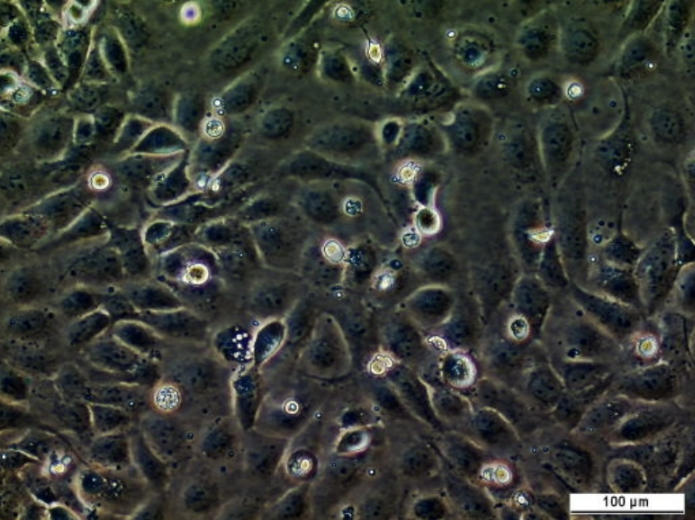
MCF7/TAMR-1 Cell Line
Tamoxifen resistant cell line which can be used to discover alternative treatments for breast cancer and understand the signalling pathways involved in tamoxifen resistance.
Contributors
| Inventor | Institute |
|---|---|
| Anne Lykkesfeldt | Danish Cancer Society, Denmark |
| Cat. #: | 152089 |
|---|---|
| Tool sub type: | Continuous |
| Unit size: | 1×10^6 cells / vial |
| Cancer types: | Breast cancer;Breast cancer |
| Organism: | Human |
| Tissue: | Breast |
| Gender: | Female |
| Model: | Tumour line |
| Growth properties: | Adherent |
| Primary citation: | Lykkesfeldt et al. 1986. Br J Cancer. 53(1):29-35. PMID: 3947513 |
| Alternate name: | MCF-7/TAMR-1; MCF7/TAMR-1; MCF7 TAMR-1; MCF-7/TAM(R)-1; MCF7-TAMR; TAMR-1; TamR-1; TamR1; AL-1 |
|---|---|
| Product description: | MCF7/TAMR-1 cell line is a stable tamoxifen-resistant subline. This cell line has been established in tissue culture after long term treatment with 1 uM tamoxifen. Tamoxifen (Nolvadex) is a widely used drug for hormone-dependent cancer. Tamoxifen resistance (either primary or acquired) makes oestrogen receptor-positive breast cancer much more difficult to treat. This cell line was produced from the parental cell line MCF7/S0.5, as a model cell system to study the effects of tamoxifen resistant cancer growth. MCF7/TAMR-1 cells are oestrogen receptor positive and progesterone receptor negative. They are growth inhibited by the pure antioestrogen fulvestrant.Previous applications of this cell line include treatment with steroidal antiestrogens. MCF7/TAMR-1 enables identification of new hormone therapies and greater understanding of the signalling pathways/methods behind tamoxifen resistance. Additionally MCF/TAMR-1 can aid in identifying new predictive markers for response to hormonal therapy. |
| Gender: | Female |
| CRISPR: | No |
| Conditional: | Yes |
| Production details: | The parental cell line for the MCF7/TAMR-1 cells is MCF7/S0.5, which was adapted to grow at low serum concentration in order to study the effect of estradiol and tamoxifen. MCF7/TAMR-1 has been established from a clone of cells that survived long term treatment with 1 uM tamoxifen. The establishment of the MCF7/TAMR-1 cell line, originally named AL-1, was first described in Lykkesfeldt et al (1986). Tamoxifen-resistant cells are passaged continuously in presence of 1 uM tamoxifen, which is le… |
| Additional notes: | During the establishment process the treatment of MCF7/S0.5 cells with tamoxifen was started in passage 351. Few colonies of cells survived the treatment and after 28 days of tamoxifen treatment, tamoxifen was omitted from the medium for 22 days. After 19 passages without tamoxifen (passage 372) the cells underwent a second treatment with tamoxifen which initially reduced cell growth rate, but around 390-400 the growth rate of the tamoxifen resistant cell lines was close to the growth rate of… |
| Cellosaurus ID: | CVCL_M436 |
| Receptors of note: | Oestrogen receptor positive and progesterone receptor negative |
| Parental cell line: | MCF7/S0.5 Cell Line |
| disease: | Cancer;Cancer |
| Format: | Frozen |
|---|---|
| Storage conditions: | Liquid Nitrogen |
| Shipping conditions: | Dry ice |
| Growth medium: | Phenol red-free DMEM/F-12 containing 1% Fetal bovine serum, 2 mM Glutamax and 6 ng/ml Insulin. To maintain high-level resistance, the medium should be supplemented with 1 uM Tamoxifen |
| Temperature: | 37° C |
| Atmosphere: | 5% CO2 |
| Recommended controls: | MCF7-S0.5 parental line |
| Mycoplasma free: | Yes |
| Biosafety level: | 1 |
| References: |
Lee et al. 2018. Autophagy. 14(5):812-824. PMID: 29130361 Martin et al. 2017. Nat Commun. 8(1):1865. PMID: 29192207 Guney Eskiler et al. 2016. Cell Biol Toxicol. :. PMID: 27585693 Joshi et al. 2016. Oncotarget. :. PMID: 27528030 Leclercq et al. 2016. J Recept Signal Transduct Res. :1-18. PMID: 27400858 Guest et al. 2016. PLoS One. 11(6):e0157397. PMID: 27308830 Alves et al. 2016. Clin Cancer Res. :. PMID: 27252418 Hole et al. 2015. Int J Oncol. 46(4):1481-90. PMID: 25625755 Elias et al. 2015. Oncogene. 34(15):1919-27. PMID: 24882577 Thrane et al. 2015. Oncogene. 34:4199–4210. PMID: 25362855 Nass et al. 2014. PLoS One. 9(7):e101473. PMID: 24983248 Thrane et al. 2013. Breast Cancer Res Treat. 139(1):71-80. PMID: 23609470 Cutrupi et al. 2012. Oncogene. 31(40):4353-61. PMID: 22249258 Plaza-Menacho et al. 2010. Oncogene. 29(33):4648-57. PMID: 20531297 Lykkesfeldt et al. 1994. Cancer Res. 54(6):1587-95. PMID: 8137264 Lykkesfeldt et al. 1986. Br J Cancer. 53(1):29-35. PMID: 3947513 |
|---|
Citations And Reviews
 Powered by Bioz
 Related Tools for Cell lines
| Cat. # | Tool Name | |||||||||||||||
|---|---|---|---|---|---|---|---|---|---|---|---|---|---|---|---|---|
| 151450 | JIM3 Cell Line |
Key Info
JIM3 Cell Line
|
View Tool | |||||||||||||
| 151484 | 2fTGH Cell Line |
Key Info
2fTGH Cell Line
|
View Tool | |||||||||||||
| 151558 | MEF Trex1 KO Cell Line |
Key Info
MEF Trex1 KO Cell Line
|
View Tool | |||||||||||||
| 151579 | U-2 OS Gal4-p300 Cell Line |
Key Info
U-2 OS Gal4-p300 Cell Line
|
View Tool | |||||||||||||
| 151626 | A375P beta6-puro Cell Line |
Key Info
A375P beta6-puro Cell Line
|
View Tool | |||||||||||||