Anti-Omomyc
Monoclonal antibody specific for Omomyc, capable of suppressing Myc-induced oncogenesis.
Contributors
| Inventor | Institute |
|---|---|
| Laura Soucek | Vall D'Hebron Institute Of Oncology (VHIO) |
| SKU: | 153657 |
|---|---|
| Product description: | Monoclonal antibody specific for Omomyc, capable of suppressing Myc-induced oncogenesis. Omomyc is a dominant-negative allele of the proto-oncogene Myc (c-Myc). Omomyc is a mutant bHLHZip domain that sequesters Myc in complexes that are unable to bind to the E box recognition element and activate transcription but remain competent for transcriptional repression. Expression of Omomyc can induce rapid tumour regression in mouse models with little toxicity for normal tissues, acting as a suppressor of Myc-induced oncogenesis. |
| Conjugation: | Unconjugated |
| Isotype: | IgG2a kappa |
| Cat. #: | 153657 |
|---|---|
| Tool sub type: | Primary antibody |
| Unit size: | 100 ug |
| Research Fields: | Apoptosis and autophagy; Cancer; Cell biology; Genetics |
| Application: | ELISA ; IHC ; IF ; WB |
| Target: | Omomyc |
| Reactivity: | Human |
| Clone: | 17 |
| Host: | Mouse |
| Class: | Monoclonal |
| Primary citation: | Soucek et al. 2004. Cell Death Differ. 11(9):1038-45. PMID: 15143346. |
| Target background: | Monoclonal antibody specific for Omomyc, capable of suppressing Myc-induced oncogenesis. Omomyc is a dominant-negative allele of the proto-oncogene Myc (c-Myc). Omomyc is a mutant bHLHZip domain that sequesters Myc in complexes that are unable to bind to the E box recognition element and activate transcription but remain competent for transcriptional repression. Expression of Omomyc can induce rapid tumour regression in mouse models with little toxicity for normal tissues, acting as a suppressor of Myc-induced oncogenesis. |
|---|
| Format: | Liquid |
|---|---|
| Concentration: | 1 mg/ml |
| Storage buffer: | PBS with 0.02% azide |
| Storage conditions: | Store at -20° C frozen. Avoid repeated freeze / thaw cycles |
| Shipping conditions: | Dry ice |
| References: |
MassĂł-VallĂŠs D et al. 2022. Cancer Res Commun. 2(2):110-130. PMID: 36860495. Fiorentino et al. 2016. Oncotarget. 7(21):31014-28. PMID: 27105536. Soucek et al. 2013. Genes Dev. 27(5):504-13. PMID: 23475959. Soucek et al. 2004. Cell Death Differ. 11(9):1038-45. PMID: 15143346. |
|---|
Images
View Gallery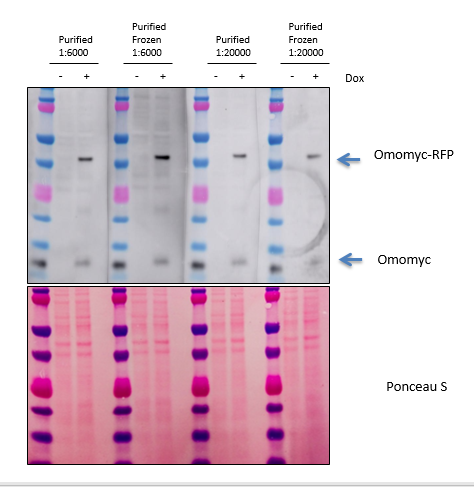
Product Images
153657 Title
A549 cells withDoxycycline-inducible Omomyc were orthotopically implanted into recipient mice. After treatment with Doxycycline