Anti-ATM [ATM 11G12]
The ATM protein is a member of the phosphatidylinositol-3 kinase family of proteins that respond to DNA damage by phosphorylating key substrates involved in DNA repair and/or cell cycle control. It is thought that the activation of ATM by autophosphorylation might be the initiating event of cellular responses to irradiation. The classic form of ataxia […]
Contributors
| Institute |
|---|
| University of Birmingham |
| Cat. #: | 151333 |
|---|---|
| Tool sub type: | Primary antibody |
| Unit size: | 100 ug |
| Research Fields: | Cancer;Cell biology;Genetics |
| Application: | IF ; IP ; WB |
| Target: | Ataxia Telangiesctasia Mutated (ATM) |
| Reactivity: | Human |
| Clone: | ATM 11G12 |
| Host: | Mouse |
| Class: | Monoclonal |
| Product description: | The ATM protein is a member of the phosphatidylinositol-3 kinase family of proteins that respond to DNA damage by phosphorylating key substrates involved in DNA repair and/or cell cycle control. It is thought that the activation of ATM by autophosphorylation might be the initiating event of cellular responses to irradiation. The classic form of ataxia telangiectasia, an autosomal recessive cerebellar ataxia, results from the presence of two truncating ATM mutations, leading to a total loss of the ATM protein. |
|---|---|
| Conjugation: | Unconjugated |
| Isotype: | IgG1 |
| Molecular weight: | 370 kDa |
| Immunogen: | Residues 992-1144 of ATM fusion protein |
| Myeloma used: | Sp2/0-Ag14 |
| Target background: | The ATM protein is a member of the phosphatidylinositol-3 kinase family of proteins that respond to DNA damage by phosphorylating key substrates involved in DNA repair and/or cell cycle control. It is thought that the activation of ATM by autophosphorylation might be the initiating event of cellular responses to irradiation. The classic form of ataxia telangiectasia, an autosomal recessive cerebellar ataxia, results from the presence of two truncating ATM mutations, leading to a total loss of the ATM protein. |
|---|
| Format: | Liquid |
|---|---|
| Concentration: | 1 mg/ml |
| Storage buffer: | PBS with 0.02% azide |
| Storage conditions: | -80° C |
| Shipping conditions: | Dry ice |
| References: |
Dynamics of DNA damage induced pathways to cancer. Tian et al. 2013. PLoS One. 8(9):e72303. PMID: 24023735. Reiman et al. 2011. Br J Cancer. 105(4):586-91. PMID: 21792198. Lymphoid tumours and breast cancer in ataxia telangiectasia substantial protective effect of residual ATM kinase activity against childhood tumours. Dutton et al. 2007. Blood. 109(6):2597-603. PMID: 17148591. Bmi-1 is induced by the Epstein-Barr virus oncogene LMP1 and regulates the expression of viral target genes in Hodgkin lymphoma cells. Clements et al. 2004. DNA Repair (Amst). 3(11):1493-502. PMID: 15380105. The ataxia-oculomotor apraxia 1 gene product has a role distinct from ATM and interacts with the DNA strand break repair proteins XRCC1 and XRCC4. Starczynski et al. 2003. Am J Pathol. 163(2):423-32. PMID: 12875964. Variations in ATM protein expression during normal lymphoid differentiation and among B-cell-derived neoplasias. |
|---|
Images
View Gallery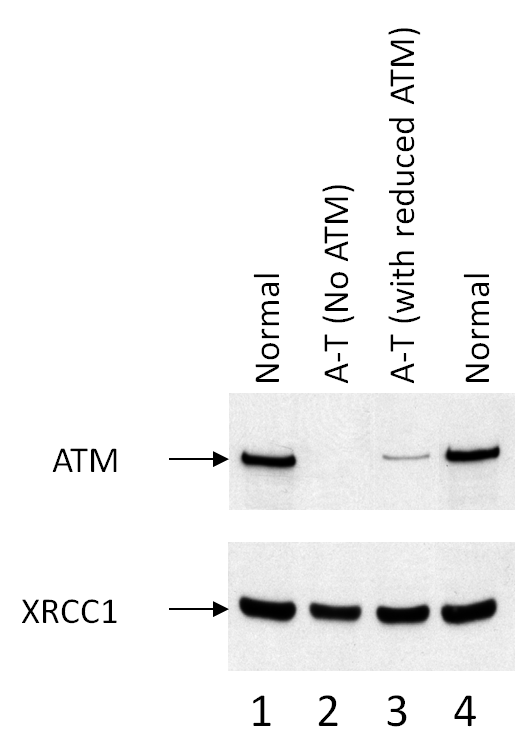
Product Images
a1664c65-482b-4713-97a5-f2217c4527d3.png
Related Tools for Antibodies
| Cat. # | Tool Name | |||||||||||||||||||||
|---|---|---|---|---|---|---|---|---|---|---|---|---|---|---|---|---|---|---|---|---|---|---|
| 151015 | Anti-CyclinA [E70.1] |
Key Info
Anti-CyclinA [E70.1]
|
View Tool | |||||||||||||||||||
| 151023 | Anti-IL12 [1-1D5] |
Key Info
Anti-IL12 [1-1D5]
|
View Tool | |||||||||||||||||||
| 151040 | Anti-CD11 & CD18 [24] |
Key Info
Anti-CD11 & CD18 [24]
|
View Tool | |||||||||||||||||||
| 151026 | Anti-FCGR1 [10.1] mAb |
Key Info
Anti-FCGR1 [10.1] mAb
|
View Tool | |||||||||||||||||||
| 151035 | Anti-CD8 [14] mAb |
Key Info
Anti-CD8 [14] mAb
|
View Tool | |||||||||||||||||||