MCF7/TAMR-4 Cell Line
A human tamoxifen-resistant breast cancer model used to study endocrine resistance, oestrogen receptor signalling, and hormone-directed therapies. Save 30% on this cell line this autumn. Use code ACA26CELL at checkout.
Contributors
| Inventor | Institute |
|---|---|
| Anne Lykkesfeldt | Danish Cancer Society, Denmark |
| SKU: | 152088 |
|---|---|
| Product description: | MCF7/TAMR-4 cell line is a stable tamoxifen-resistant subline. This cell line was produced from the parental cell line MCF7/S0.5, as a model cell system to study the effects of tamoxifen resistant cancer growth. MCF7/TAMR-4 cells are oestrogen receptor positive and progesterone receptor negative, and are growth inhibited by the pure antioestrogen fulvestrant. MCF7/TAMR-4 enables identification of new hormone therapies and greater understanding of the signalling pathways/methods behind tamoxifen resistance. Additionally, this line can aid in identifying new predictive markers for response to hormonal therapy. |
| Alternate name: | MCF-7/TAMR-4 Cell Line |
| Gender: | Female |
| Conditional: | Yes |
| Production details: | The parental cell line for the MCF7/TAMR-4 cells is MCF7/S0.5, which was adapted to grow at low serum concentration in order to study the effect of estradiol and tamoxifen. MCF7/TAMR-4 has been established from a clone of cells that survived long term treatment with 1 uM tamoxifen. Tamoxifen-resistant cells are passaged continuously in presence of 1 uM tamoxifen, which is lethal for the parental MCF7/S0.5 cell line. |
| Additional notes: | MCF7/TAMR-4 cells are oestrogen receptor positive and progesterone receptor negative. MCF7/TAMR-4 cells are growth inhibited by the pure antiestrogen fulvestrant. The oestrogen receptor is a major driver of growth of MCF7/TAMR-4 cell, ref 1. Treatment targeting the Aurora kinase A restores sensitivity to tamoxifen treatment. The TAMR lines were established from the MCF7/S0.5 cell line, which was adapted to grow with 0.5% fetal calf serum in phenol red containing DMEM/F12 medium. Treatment wi… |
| Cellosaurus ID: | CVCL_1D42 |
| Parental cell line: | MCF7 S0.5 |
| Disease: | Cancer |
| Related tools: | MCF7/S0.5 Cell Line |
| Cat. #: | 152088 |
|---|---|
| Tool sub type: | Continuous |
| Unit size: | 1×10^6 cells / vial |
| Cancer types: | Breast cancer |
| Organism: | Human |
| Tissue: | Breast |
| Gender: | Female |
| Model: | Tumour line |
| Format: | Frozen |
|---|---|
| Storage conditions: | Liquid Nitrogen |
| Shipping conditions: | Dry ice |
| Growth medium: | DMEM:Ham’s F-12 phenol red-free medium containing 1% fetal bovine serum, 2 mM Glutamax and 6 ng/ml insulin. To maintain high-level resistance, medium was supplemented with Tamoxifen (1 uM). |
| Temperature: | 37° C |
| Atmosphere: | 5% CO2 |
| Recommended controls: | MCF7-S0.5 parental line |
| Mycoplasma free: | Yes |
| Biosafety level: | 1 |
| References: |
Joshi et al. 2016. Oncotarget. 7(35):57239-57253. PMID: 27528030. Elias et al. 2015. Oncogene. 34(15):1919-1927. PMID: 24882577. Thrane et al. 2015. Oncogene. 34:4199–4210. PMID: 25362855. Thrane et al. 2013. Breast Cancer Res Treat. 139(1):71-80. PMID: 23609470. Cutrupi et al. 2012. Oncogene. 31(40):4353-4361. PMID: 22249258. Millour et al. 2010. Oncogene. 29(20):2983-2995. PMID: 20208560. Pancholi et al. 2008. Endocr Relat Cancer. 15(4):985-1002. PMID: 18824559. Sarwar et al. 2006. Endocr Relat Cancer. 13(3):851-861. PMID: 16954434. |
|---|
Images
View Gallery
Product Images
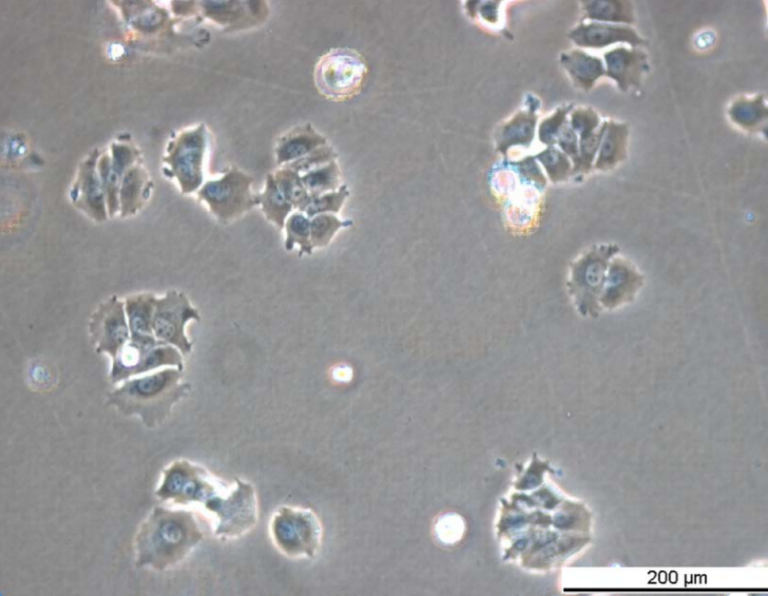
MCF7 TAMR-4 cells
MCF7 TAMR-4 Cell Line. Early log phase. Image courtesy of the European Collection of Authenticated Cell Cultures (ECACC), UK.
Related Tools for Cell lines
| Cat. # | Tool Name | |||||||||||||
|---|---|---|---|---|---|---|---|---|---|---|---|---|---|---|
| 152086 | MCF7/TAMR-8 Cell Line |
Key Info
MCF7/TAMR-8 Cell Line
|
View Tool | |||||||||||
| 152087 | MCF7/TAMR-7 Cell line |
Key Info
MCF7/TAMR-7 Cell line
|
View Tool | |||||||||||
| 152089 | MCF7/TAMR-1 Cell Line |
Key Info
MCF7/TAMR-1 Cell Line
|
View Tool | |||||||||||
| 152090 | MCF7/S0.5 Cell Line |
Key Info
MCF7/S0.5 Cell Line
|
View Tool | |||||||||||