Holiday shipping dates:
Last international orders dispatched: Friday 11th December
Last UK domestic orders dispatched: Wednesday 16th December
Following the holiday period, shipping will resume as normal from the week commencing Monday 4th January 2027
Anti-deltaEGFR [DH8.3] mAb
Exclusive toolMonoclonal antibody directed against deltaEGFR, also known as EGFRvIII, a mutated form of EGFR, typically found in glioblastomas. This antibody has use within radiolabelled tumour imaging and potentially therapeutic targeting against deltaEGFR tumours.
Contributors
| Inventor | Institute |
|---|---|
| Bill Gullick | Cancer Research UK, London Research Institute: Lincoln's Inn Fields |
| SKU: | 152934 |
|---|---|
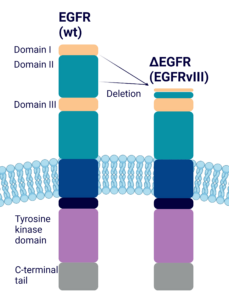
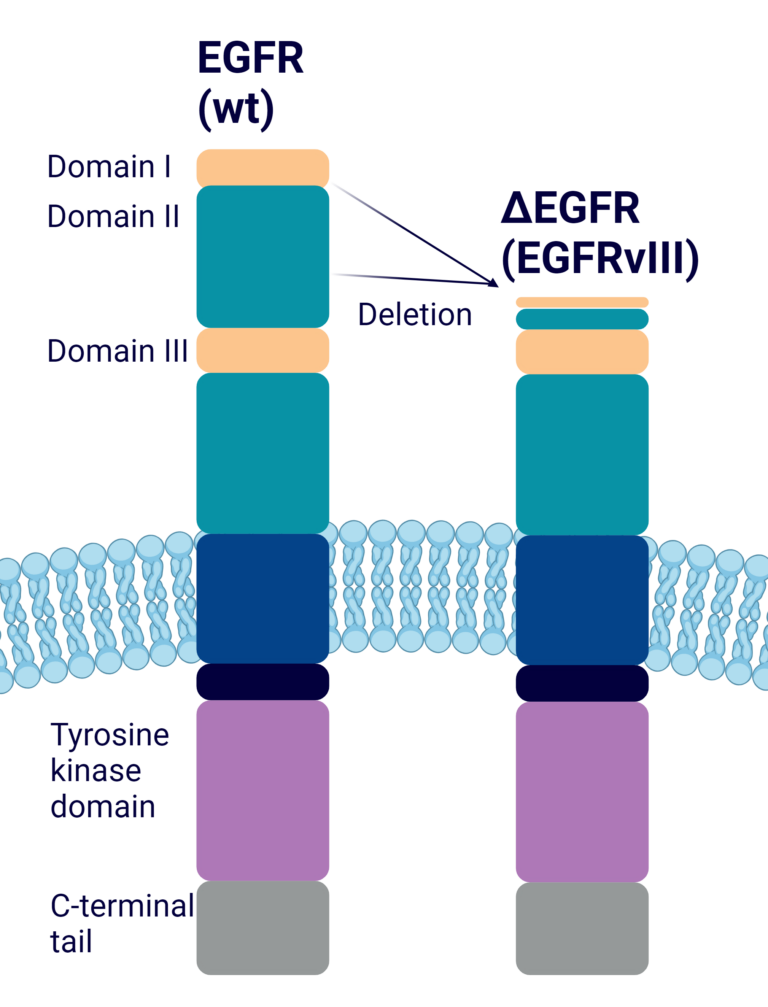
| Product description: | Monoclonal antibody directed against ΔEGFR, a mutated form of EGFR, typically found in brain tumours, also known as EGFRvIII. This antibody has use within radiolabelled tumour imaging and potentially therapeutic targeting against ΔEGFR tumours. Background and Research Applications: Epidermal growth factor (EGFR) has attracted considerable attention as a target for cancer therapy. Wild-type EGFR is amplified in a number of cancers, and several mutant forms of the EGFR coding gene have been found. ΔEGFR is the most common mutation, with a deletion of exons 2-7 in the external domain of wt-EGFR, generating a truncated form of EGFR. Anti-ΔEGFR [DH8.3] is raised to a synthetic peptide that recognises the junctional region of the ΔEGFR receptor. Points of Interest Anti-ΔEGFR [DH8.3] does not recognise the natural, wild-type form of EGFR receptor, so therefore does not cross react with the full-length receptor. It only binds cells expressing the mutant receptor. This antibody can be used in tumour imaging, with radiolabelled antibody DH8.3. This antibody has successfully targeted tumours expressing DH8.3 antigen in nude mice. This antibody recognises ΔEGFR in both denatured and native states. |
| Alternate name: | EGFRvIII, Avian erythroblastic leukemia viral (v erb b) oncogene homolog, Cell growth inhibiting protein 4, Cell proliferation inducing protein 61, EGF R, EGFR, Epidermal growth factor receptor (avian erythroblastic leukemia viral (v erb b) oncogene homolog), Epidermal growth factor receptor (erythroblastic leukemia viral (v erb b) oncogene homolog avian), Epidermal growth factor receptor, erb-b2 receptor tyrosine kinase 1, ERBB, ERBB1, Errp, HER1, mENA, NISBD2, Oncogen ERBB, PIG61, Proto-onc… |
| Conjugation: | Unconjugated |
| Isotype: | IgG1 kappa |
| Immunogen: | Synthetic peptide corresponding to the junctional region of the truncated receptor LEEKKGNYVVTDHC,conjugated to keyhole limpet haemcyanin. |
| Immunogen Uniprot ID: | P00533 |
| Myeloma used: | NS0 |
| Cat. #: | 152934 |
|---|---|
| Provenance and Ownership: | The Anti-deltaEGFR [DH8.3] mAb is owned by Cancer Research UK. CancerTools supplies the Anti-deltaEGFR [DH8.3] mAb under licence from Cancer Research UK and is the authorised source for its distribution. Sourcing Anti-deltaEGFR [DH8.3] mAb directly from the IP owner ensures authenticity, provenance and compliance with all applicable licensing and research use requirements. |
| Tool sub type: | Primary antibody |
| Unit size: | 100 ug |
| Cancer types: | Brain cancer |
| Research Fields: | Cancer; Cell signaling and signal transduction |
| Application: | ELISA ; FACS ; IHC ; IP ; WB |
| Target: | Epidermal growth factor receptor, truncated EGF receptor (RGFR typeIII/EGFRvIII/deltaEGFR). Recognises an EGFR with truncated extracellular domain, present on human tumours. |
| Reactivity: | Human |
| Clone: | DH8.3 |
| Host: | Mouse |
| Class: | Monoclonal |
| Primary citation: | Hills et al. 1995. Int J Cancer. 63(4):537-43. PMID: 7591264. |
| Target background: | ΔEGFR is the most common alteration observed in glioblastomas. It has a deletion of exons 2 to 7 in the external domain of wt-EGFR, generating a truncated form of EGFR. This truncated EGFRvIII is constitutively active. In this genetic rearrangement where exon 1 is spliced to exon 8, resulting in the loss of 801 bp from the mature mRNA. This corresponds to a deletion of 267 amino acids in the receptor’s extracellular domain. The structure of the receptor is then unable to bind ligand, yet is constitutively active, enhancing tumorigenesis due to impaired internalisation and degradation. |
|---|
| Format: | Liquid |
|---|---|
| Concentration: | 1 mg/ml |
| Storage buffer: | PBS with 0.02% azide |
| Storage conditions: | Store at -20° C frozen. Avoid repeated freeze / thaw cycles |
| Shipping conditions: | Dry ice |
| References: |
Genßler et al. 2016. Oncoimmunology. 5(4):e1119354. PMID: 27141401 Feng et al. 2014. J Clin Invest. 124(9):3741-56. PMID: 25061874 Feng et al. 2012. Proc Natl Acad Sci U S A. 109(8):3018-23. PMID: 22323579 Lammering et al. 2004. Clin Cancer Res. 10(19):6732-43. PMID: 15475464 Nishikawa et al. 2004. Brain Tumor Pathol. 21(2):53-6. PMID: 15700833 Jungbluth et al. 2003. Proc Natl Acad Sci U S A. 100(2):639-44. PMID: 12515857 Johns et al. 2002. Int J Cancer. 98(3):398-408. PMID: 11920591 Hills et al. 1995. Int J Cancer. 63(4):537-43. PMID: 7591264 |
|---|
Images
View Gallery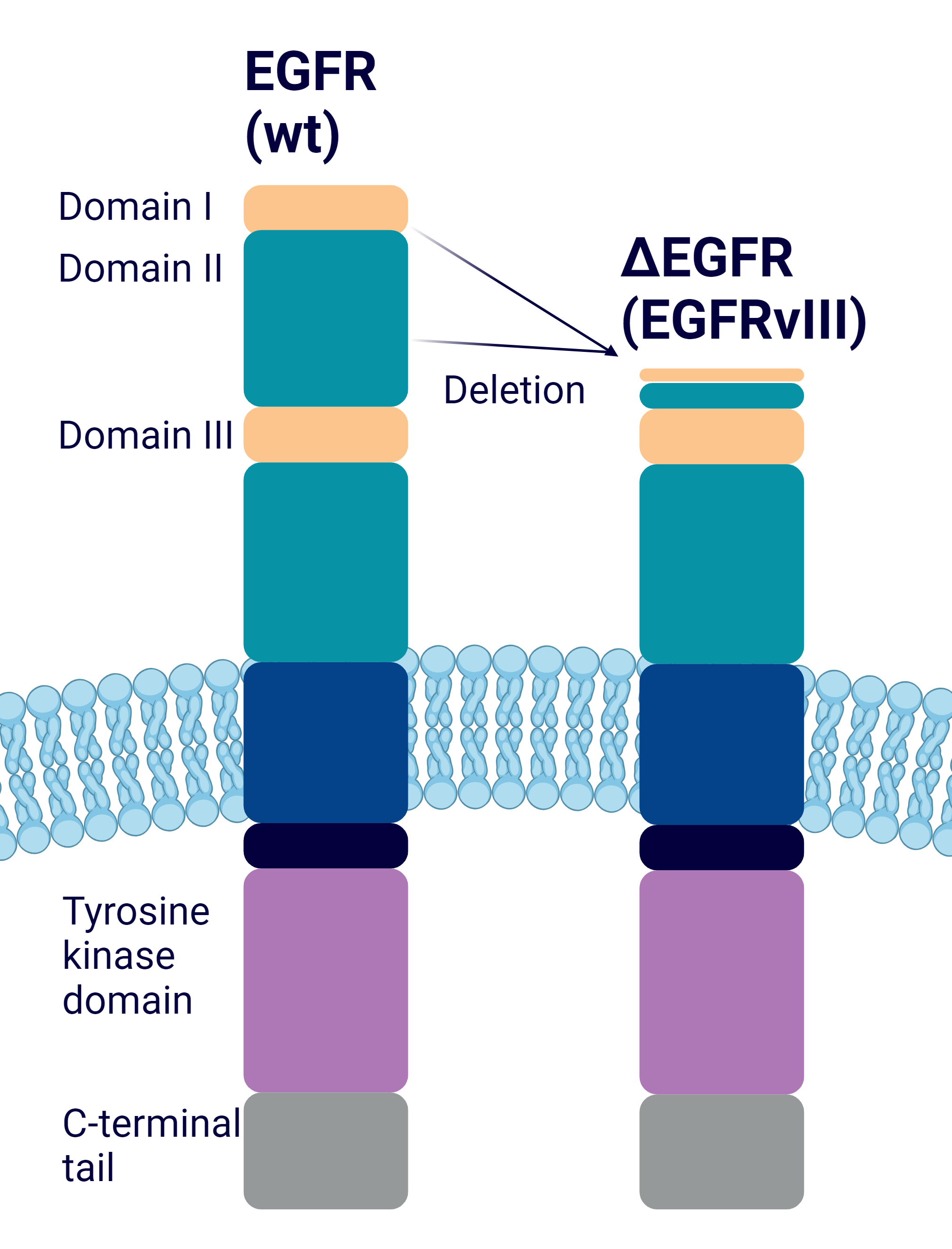
Product Images
Anti-deltaEGFR EGFRvIII [DH8.3]152934
Diagram illustrating the truncation of EGFR in EGFRvIII (deltaEGFR)