Anti-RSV G Glycoprotein [11-2-D2]
Human Respiratory Syncytial Virus (HRSV) is a major cause of lower respiratory tract illness and is the chief cause of hospitalization for respiratory tract illness in young children. The glycoprotein G (also named GP90) is located on the surface of viral envelope, its function is to attach to host cell receptors. It has a high […]
Contributors
| Inventor | Institute |
|---|---|
| Ayham Alnabulsi | Vertebrate Antibodies Limited |
| Cat. #: | 151859 |
|---|---|
| Unit size: | 100 ug |
| Research Fields: | Microbiology |
| Application: | ELISA ; IF ; Fn ; WB |
| Target: | Human Respiratory Syncytial (RS) virus G glycoprotein |
| Reactivity: | Virus |
| Clone: | 11-2-D2 |
| Host: | Mouse |
| Class: | Monoclonal |
| Alternate name: | GP9 |
|---|---|
| Product description: | Human Respiratory Syncytial Virus (HRSV) is a major cause of lower respiratory tract illness and is the chief cause of hospitalization for respiratory tract illness in young children. The glycoprotein G (also named GP90) is located on the surface of viral envelope, its function is to attach to host cell receptors. It has a high content (90%) of carbohydrate. Validation of the monoclonal antibodies by immunoblotting: Purified extracellular RSV was used as the antigen in two adjacent lanes and the virus proteins resolved by gel electrophoresis. The proteins were transferred to membrane. The proteins for one lane were incubated with the MAb to be validated and the other lane incubated with either convalescent human sera (HuS), containing antibodies to all the RSV proteins, or RSV antiserum raised in mice. Human sera containing antibodies to the RSV proteins were characterised by immunoblot using purified RS virus (Gimenez et al, 1987). The protein molecular weights were determined by co-electrophoresis with standard protein markers obtained from Sigma, their locations are marked on the figure. The identity and molecular weights of the RSV proteins (VP) were well documented by the time the validation was done and are indicated in the figure. The methods used provided not only the identity of the virus protein reacting with the MAb but also its molecular weight. The validation of the RSV MAbs using this approach is described in the publication list. Validation of the monoclonal antibodies by indirect immunofluorescence: positive staining of fixed RSA-2 infected BSC-1 cells. This antibody does not cross-react with other RSV proteins. To our knowledge, this antibody and the antibodies 4-15, 11-5-G9 are the only HRS virus specific antibodies reported to induce in vitro antibody-dependent enhancement. |
| Conjugation: | Unconjugated |
| Isotype: | IgG2a kappa |
| Immunogen: | Gradient-purified RSF-44 virus (subgroup A) UV inactivated for 20 minutes at 20C |
| Myeloma used: | P3X63Ag8.653 |
| Target background: | Human Respiratory Syncytial Virus (HRSV) is a major cause of lower respiratory tract illness and is the chief cause of hospitalization for respiratory tract illness in young children. The glycoprotein G (also named GP90) is located on the surface of viral envelope, its function is to attach to host cell receptors. It has a high content (90%) of carbohydrate. Validation of the monoclonal antibodies by immunoblotting: Purified extracellular RSV was used as the antigen in two adjacent lanes and the virus proteins resolved by gel electrophoresis. The proteins were transferred to membrane. The proteins for one lane were incubated with the MAb to be validated and the other lane incubated with either convalescent human sera (HuS), containing antibodies to all the RSV proteins, or RSV antiserum raised in mice. Human sera containing antibodies to the RSV proteins were characterised by immunoblot using purified RS virus (Gimenez et al, 1987). The protein molecular weights were determined by co-electrophoresis with standard protein markers obtained from Sigma, their locations are marked on the figure. The identity and molecular weights of the RSV proteins (VP) were well documented by the time the validation was done and are indicated in the figure. The methods used provided not only the identity of the virus protein reacting with the MAb but also its molecular weight. The validation of the RSV MAbs using this approach is described in the publication list. Validation of the monoclonal antibodies by indirect immunofluorescence: positive staining of fixed RSA-2 infected BSC-1 cells. This antibody does not cross-react with other RSV proteins. To our knowledge, this antibody and the antibodies 4-15, 11-5-G9 are the only HRS virus specific antibodies reported to induce in vitro antibody-dependent enhancement. |
|---|
| Format: | Liquid |
|---|---|
| Concentration: | 1 mg/ml |
| Storage buffer: | DulbeccoĂÂs media containing 20% Fetal Bovine serum (DH20) prepared as follows (for final volume of 300ml: 237ml DMEM plus 60 ml Fetal Bovine Serum plus 3ml L-Glutamine). |
| Storage conditions: | -15° C to -25° C |
| Shipping conditions: | Dry ice |
| References: |
Gimenez et al. 1989. Journal General Virology, 70: 89-96. PMID: 2732688 Gimenez et al. 1996. Clinical and Diagnostic Laboratory Immunology, 3: 280-86, PMID: 8705669 Gimenez et al. 1987. Journal General Virology, 68: 1267-75. PMID: 3572364. |
|---|
Images
View Gallery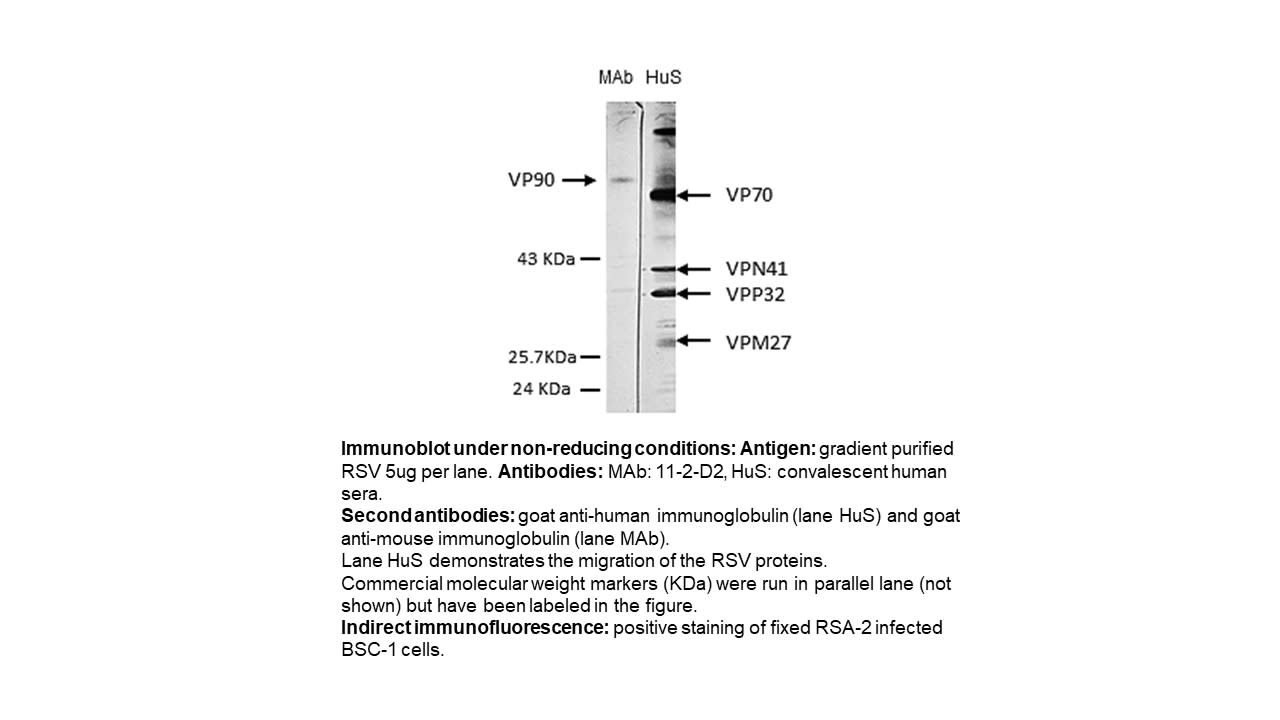
Product Images
bfe998e7-57ae-4b8c-89d0-eaa1fb9490b5.jpg
Related Tools for Antibodies
| Cat. # | Tool Name | |||||||||||||||||||||
|---|---|---|---|---|---|---|---|---|---|---|---|---|---|---|---|---|---|---|---|---|---|---|
| 151023 | Anti-IL12 [1-1D5] |
Key Info
Anti-IL12 [1-1D5]
|
View Tool | |||||||||||||||||||
| 151029 | Anti-HSVICP8 [11E2] |
Key Info
Anti-HSVICP8 [11E2]
|
View Tool | |||||||||||||||||||
| 151033 | Anti-HSVUL42 [13C9] |
Key Info
Anti-HSVUL42 [13C9]
|
View Tool | |||||||||||||||||||
| 151037 | Anti-Cdk1 [17 (A17)] |
Key Info
Anti-Cdk1 [17 (A17)]
|
View Tool | |||||||||||||||||||
| 151020 | Anti-CyclinB1 [V143.1] |
Key Info
Anti-CyclinB1 [V143.1]
|
View Tool | |||||||||||||||||||