Anti-RA015/11.91 [11.91]
Rheumatoid arthritis (RA) is a joint-destructive inflammatory disorder characterized by breach of self-tolerance and production of antiÄËĂÂĂÂcit-peptide/protein Abs (ACPA). In the RA synovium, ectopic germinal centers (GCs) support an autoantigen-driven immune response leading to local ACPA+ B cell differentiation (1, 2). Recently, we reported that autoreactive B cells highly mutated within ectopic GCs frequently target […]
Contributors
| Institute |
|---|
| Queen Mary University of London |
| Cat. #: | 160521 |
|---|---|
| Unit size: | 100 ug |
| Research Fields: | Drug development;Neurobiology |
| Application: | ELISA ; WB |
| Target: | Neutrophil Extracellular Trap Antigen |
| Clone: | 11.91 |
| Host: | Human |
| Class: | Recombinant |
| Alternate name: | NET (Neutrophil Extracellular Trap) |
|---|---|
| Product description: | Rheumatoid arthritis (RA) is a joint-destructive inflammatory disorder characterized by breach of self-tolerance and production of antiÄËĂÂĂÂcit-peptide/protein Abs (ACPA). In the RA synovium, ectopic germinal centers (GCs) support an autoantigen-driven immune response leading to local ACPA+ B cell differentiation (1, 2). Recently, we reported that autoreactive B cells highly mutated within ectopic GCs frequently target cit-histones (cit-H2A/B) contained in neutrophil extracellular traps (NETs) (3). Somatic hypermutation (SHM) within GCs introduces single-point mutations in the variable heavy (VH) and/or variable light (VL) region of unmutated (germline) BCR, thus regulating Ag-driven B cell affinity maturation (4). Additionally, SHM can introduce N-glycosylation sites in the VH/VL regions, which can influence Ag binding and/or give an advantage during the selection process to autoreactive B cells (5ÄËĂÂĂÂ7). Circulating and synovial fluid ACPA-IgG are extensively N-glycosylated in their Fab domain and this is due to introduction of N-glycosylation sites during SHM. The biological effects mediated by the glycans in the variable domain of ACPA-IgG might modulate either the Ag binding and/or BCR signalling or might influence the binding to lectins thus giving survival signals to autoreactive B cells (5, 7, 8). Therefore, additional studies are necessary to enhance our understanding of ACPA-IgG Fab N-glycans. In particular, a direct demonstration of the relative contribution of SHM in the VH versus VL region and of the importance of Fab N-glycosylation sites for synovial B cell recognition of cit-Ags is missing. Therefore, in this study we characterized the requirement for SHM within the VH and VL regions and of Fab N-linked glycosylation for the immunoreactivity to NETs and cit-H2B in RA-rmAbs derived from CD19+ B cells obtained from ectopic lymphoid structure (ELS)+ RA synovial tissues. In particular, we present three different scenarios whereby 1) SHM in the VH region is sufficient for the binding to NETs/cit-H2B; 2) both VH and VL chain affinity maturation contribute to the immunoreactivity; and 3) the introduction of a single Fab N-glycosylation site account for most of the RA-rmAbs binding to cit-H2B. PMID: 32221039J Immunol. 2020 May 1;204(9):2374-2379. doi: 10.4049/jimmunol.1901457. Epub 2020 Mar 27. |
| Conjugation: | Unconjugated |
| Immunogen: | TBD |
| Immunogen Uniprot ID: | TBD |
| Target background: | Rheumatoid arthritis (RA) is a joint-destructive inflammatory disorder characterized by breach of self-tolerance and production of antiÄËĂÂĂÂcit-peptide/protein Abs (ACPA). In the RA synovium, ectopic germinal centers (GCs) support an autoantigen-driven immune response leading to local ACPA+ B cell differentiation (1, 2). Recently, we reported that autoreactive B cells highly mutated within ectopic GCs frequently target cit-histones (cit-H2A/B) contained in neutrophil extracellular trap… |
|---|
| Format: | Liquid |
|---|---|
| Shipping conditions: | Dry ice |
| References: |
Corsiero et al. 2020. J Immunol. 204(9):2374-2379. PMID: 32221039. |
|---|
Images
View Gallery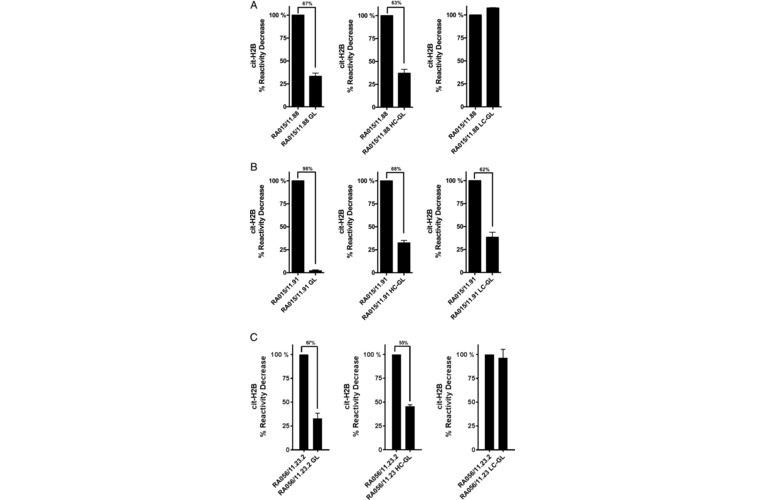
Product Images
c869cb93-0470-4a26-b768-8b003a9aedf2

Related Tools for Antibodies
| Cat. # | Tool Name | |||||||||||||||||||||
|---|---|---|---|---|---|---|---|---|---|---|---|---|---|---|---|---|---|---|---|---|---|---|
| 151015 | Anti-CyclinA [E70.1] |
Key Info
Anti-CyclinA [E70.1]
|
View Tool | |||||||||||||||||||
| 151021 | Anti-CyclinB1 [V152] |
Key Info
Anti-CyclinB1 [V152]
|
View Tool | |||||||||||||||||||
| 151026 | Anti-FCGR1 [10.1] mAb |
Key Info
Anti-FCGR1 [10.1] mAb
|
View Tool | |||||||||||||||||||
| 151027 | Anti-HSVICP8 [10A3] |
Key Info
Anti-HSVICP8 [10A3]
|
View Tool | |||||||||||||||||||
| 151033 | Anti-HSVUL42 [13C9] |
Key Info
Anti-HSVUL42 [13C9]
|
View Tool | |||||||||||||||||||