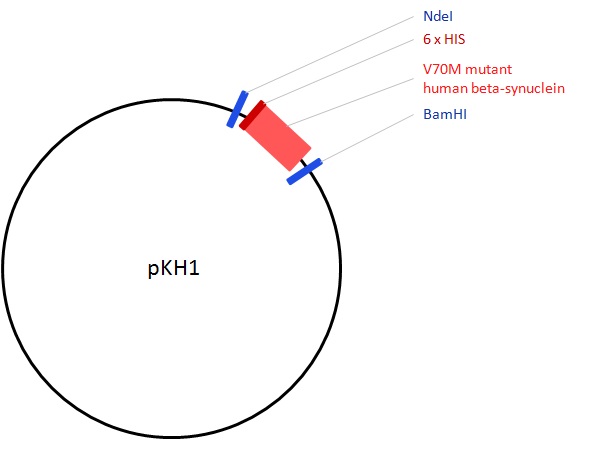
pKH1 (“V70M”) is a derivative of pET15b with the open reading frame encoding the V70M mutant human beta-synuclein (ÄÂĂÂ-synuclein) cloned in via the vector NdeI and BamHI restriction sites. It was constructed via site-specific mutagenesis of pJEK12 (pET15b-wt ÄÂĂÂ-synuclein), replacing the G at position 208 in the ORF nucleotide sequence with A, thus altering the 70th codon from GTG encoding valine (V) to ATG encoding methionine (M). In this construct V70M ÄÂĂÂ-synuclein is expressed as a fusion protein with an N-terminal six His tag.
Additional notes:
Beta synuclein is an abundant pre-synaptic phosphoprotein that is found in the brain and is homolgous to alpha-synuclein. Beta-synuclein is distinct from alha-synuclein in that it lacks the majority of the hydrophobic non-amyloid-beta component of the Alzeheimer’s disease amyloid region. Due to this beta-synuclein is less likely to form insoluble aggregates when compared to alpha-synuclein. It is thought that beta-synuclein may have a protective role against alpha-synucleinopathies.
Overexpression of β-synuclein mutants (P123H and V70M) in neuroblastoma cells results in enhanced lysosomal pathology suggesting a causative role for these missense mutations in neurodegeneration stimulation
Cat. #:
152052
Research Fields:
Neurobiology
Application notes:
pKH1 (“V70M”) is a derivative of pET15b with the open reading frame encoding the V70M mutant human beta-synuclein (β-synuclein) cloned in via the vector NdeI and BamHI restriction sites. It was constructed via site-specific mutagenesis of pJEK12 (pET15b-wt β-synuclein), replacing the G at position 208 in the ORF nucleotide sequence with A, thus altering the 70th codon from GTG encoding valine (V) to ATG encoding methionine (M). In this construct V70M β-synuclein is expressed as a fusion protein with an N-terminal six His tag.
Please ensure you use your organisation email address rather than personal where possible, as this helps us locate your organisation in our system faster.
Please note we may take up to three days to respond to your enquiry.
CancerTools.org uses the contact information provided to respond to you about our research tools and service. For more information please review our privacy policy.