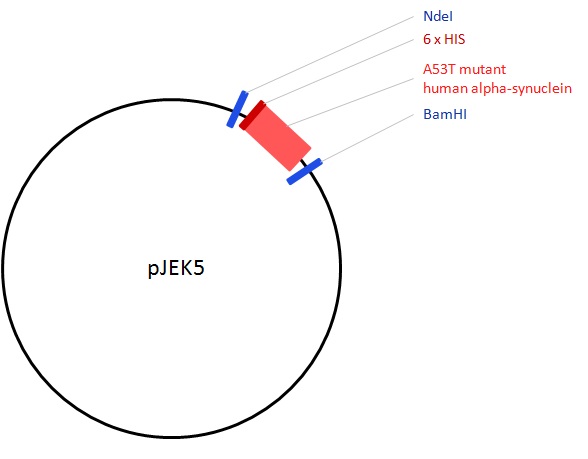
pJEK5 (“A53T”) is a derivative of pET15b with the open reading frame encoding the A53T mutant human ÄÂĂÂ -synuclein cloned in via the NdeI and BamHI restriction sites. It was constructed via site-specific mutagenesis of pJEK1, replacing the G at position 88 in the ORF nucleotide sequence with a C, thus altering the 30th codon from GCA encoding Ala, to CCA encoding Pro. In this construct A30P alpha-synuclein is expressed as a fusion protein with an N-terminal six His tag.
Additional notes:
Alpha synuclein is expressed predominantly in the brain, where it is concentrated in presynaptic nerve terminals. The deposition of the abundant presynaptic brain protein alpha-synuclein as fibrillary aggregates in neurons or glial cells is a hallmark lesion in a subset of neurodegenerative disorders. These disorders include Parkinson’s disease (PD), dementia with Lewy bodies (DLB) and multiple system atrophy, collectively referred to as synucleinopathies. Parkinson’s disease (PD) is a common neurodegenerative disorder characterized by the progressive accumulation in selected neurons of protein inclusions containing alpha-synuclein and ubiquitin.
A point mutation in the α-synuclein gene, A53T (Ala53-Thr), is linked to familial Parkinson′s disease. Mice expressing A53T human α-synuclein, but not wild-type or the A30P variants, develop adult-onset neurodegenerative disease with a progressive motoric dysfunction leading to death
Cat. #:
152048
Research Fields:
Neurobiology
Application notes:
pJEK5 (“A53T”) is a derivative of pET15b with the open reading frame encoding the A53T mutant human α-synuclein cloned in via the NdeI and BamHI restriction sites. It was constructed via site-specific mutagenesis of pJEK1, replacing the G at position 88 in the ORF nucleotide sequence with a C, thus altering the 30th codon from GCA encoding Ala, to CCA encoding Pro. In this construct A30P alpha-synuclein is expressed as a fusion protein with an N-terminal six His tag.
Please ensure you use your organisation email address rather than personal where possible, as this helps us locate your organisation in our system faster.
Please note we may take up to three days to respond to your enquiry.
CancerTools.org uses the contact information provided to respond to you about our research tools and service. For more information please review our privacy policy.