Anti-Nanog [Nanog]
Nanog is a transcription factor critically involved with self-renewal of undifferentiated embryonic stem cells. Human NANOG protein is a 305 amino acid protein with a conserved homeodomain motif that is localized to the nuclear component of cells. The homeodomain region facilitates DNA binding.
Contributors
| Inventor | Institute |
|---|---|
| Fiona Watt | Cancer Research UK, London Research Institute: Lincoln's Inn Fields |
| Cat. #: | 151719 |
|---|---|
| Provenance and Ownership: | The Anti-Nanog [Nanog] is owned by Cancer Research UK. CancerTools supplies the Anti-Nanog [Nanog] under licence from Cancer Research UK and is the authorised source for its distribution. Sourcing Anti-Nanog [Nanog] directly from the IP owner ensures authenticity, provenance and compliance with all applicable licensing and research use requirements. |
| Tool sub type: | Primary antibody |
| Unit size: | 100 ug |
| Research Fields: | Cancer;Cell biology;Developmental biology;Genetics;Stem cell biology |
| Application: | ChIP ; FACS ; IF ; IP ; WB |
| Target: | Nanog |
| Reactivity: | Human |
| Clone: | Nanog |
| Host: | Rabbit |
| Class: | Polyclonal |
| Product description: | Nanog is a transcription factor critically involved with self-renewal of undifferentiated embryonic stem cells. Human NANOG protein is a 305 amino acid protein with a conserved homeodomain motif that is localized to the nuclear component of cells. The homeodomain region facilitates DNA binding. Overexpression of Nanog in mouse embryonic stem cells causes them to self-renew in the absence of Leukemia inhibitory factor. In the absence of Nanog, mouse embryonic stem cells differentiate into visceral/parietal endoderm. Loss of Nanog function causes differentiation of mouse embryonic stem cells into other cell types. NANOG overexpression in human embryonic stem cells enables their propagation for multiple passages during which the cells remain pluripotent. Gene knockdown of Nanog promotes differentiation, thereby demonstrating a role for these factors in human embryonic stem cell self-renewal. |
|---|---|
| Conjugation: | Unconjugated |
| Immunogen: | Purified GST-Nanog 1-95 fusion protein |
| Target background: | Nanog is a transcription factor critically involved with self-renewal of undifferentiated embryonic stem cells. Human NANOG protein is a 305 amino acid protein with a conserved homeodomain motif that is localized to the nuclear component of cells. The homeodomain region facilitates DNA binding. Overexpression of Nanog in mouse embryonic stem cells causes them to self-renew in the absence of Leukemia inhibitory factor. In the absence of Nanog, mouse embryonic stem cells differentiate into visceral/parietal endoderm. Loss of Nanog function causes differentiation of mouse embryonic stem cells into other cell types. NANOG overexpression in human embryonic stem cells enables their propagation for multiple passages during which the cells remain pluripotent. Gene knockdown of Nanog promotes differentiation, thereby demonstrating a role for these factors in human embryonic stem cell self-renewal. |
|---|
| Format: | Liquid |
|---|---|
| Concentration: | 1.5 mg/ml |
| Storage buffer: | Whole serum |
| Storage conditions: | -15° C to -25° C |
| Shipping conditions: | Dry ice |
| References: |
Torres et al. 2008. Nat Cell Biol. 10(2):194-201. PMID: 18223644. Nanog maintains pluripotency of mouse embryonic stem cells by inhibiting NFkappaB and cooperating with Stat3. |
|---|
Images
View Gallery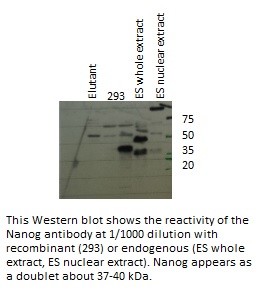
Product Images
46c86470-409b-4a68-a77d-7cdc8bcbda5e.jpg
Related Tools for Antibodies
| Cat. # | Tool Name | |||||||||||||||||||||
|---|---|---|---|---|---|---|---|---|---|---|---|---|---|---|---|---|---|---|---|---|---|---|
| 151025 | Anti-Vascular endothelium [10] |
Key Info
Anti-Vascular endothelium [10]
|
View Tool | |||||||||||||||||||
| 151027 | Anti-HSVICP8 [10A3] |
Key Info
Anti-HSVICP8 [10A3]
|
View Tool | |||||||||||||||||||
| 151026 | Anti-FCGR1 [10.1] mAb |
Key Info
Anti-FCGR1 [10.1] mAb
|
View Tool | |||||||||||||||||||
| 151030 | Anti-Progesterone [11P14] |
Key Info
Anti-Progesterone [11P14]
|
View Tool | |||||||||||||||||||
| 151018 | Anti-Mos [R38.1] |
Key Info
Anti-Mos [R38.1]
|
View Tool | |||||||||||||||||||