Anti-CYP450 Aromatase [H4]
Clone H4 recognizes a conserved epitope on the CYP450 aromatase, allowing for detection of aromatase levels using various analysis methods.
Contributors
| Institute |
|---|
| BioServ UK Ltd |
| SKU: | 153638 |
|---|---|
| Product description: | CYP450 Aromatase is part of the CYP19A1 family involved in the aromatization of androgens to estrogens, a highly conserved mechanism amongst mammals. Clone H4 recognizes a conserved epitope on the CYP450 aromatase, allowing for detection of aromatase levels using various analysis methods. |
| Alternate name: | Aromatase, CYPXIX, Cytochrome P-45AROM, Cytochrome P45 19A1, Estrogen synthase, CYP19A1, ARO1, CYAR, CYP19 |
| Conjugation: | Unconjugated |
| Isotype: | IgG2a |
| Molecular weight: | 55 kDa |
| Immunogen: | Synthetic peptide corresponding to AAs 376-390 of human aromatase (KALEDDVIGYPVKK) |
| Myeloma used: | Sp2/0-Ag14 |
| Cat. #: | 153638 |
|---|---|
| Tool sub type: | Primary antibody |
| Unit size: | 100 ug |
| Research Fields: | Cell signaling and signal transduction |
| Application: | IHC ; IF ; WB |
| Target: | CYP450 Aromatase |
| Reactivity: | Human |
| Clone: | H4 |
| Host: | Mouse |
| Class: | Monoclonal |
| Target background: | CYP450 Aromatase is part of the CYP19A1 family involved in the aromatization of androgens to estrogens, a highly conserved mechanism amongst mammals. Clone H4 recognizes a conserved epitope on the CYP450 aromatase, allowing for detection of aromatase levels using various analysis methods. |
|---|
| Format: | Liquid |
|---|---|
| Shipping conditions: | Dry ice |
| References: |
Amanatullah et al. 2017. Breast Cancer Res. 19(1):121. PMID: 29141657. Local estrogen axis in the human bone microenvironment regulates estrogenreceptor-positivebreast cancer cells. Wilsher et al. 2013. Reproduction. 145(6):541-54. PMID: 23550169. Ovarian and placental morphology and endocrine functions in the pregnant giraffe (Giraffa camelopardalis). Campbell et al. 2012. Endocrinology. 153(9):4533-43. PMID: 22778215. The role of anti-Mllerian hormone (AMH) during follicle development in a monovulatory species (sheep). Mlodawska et al. 2010. Theriogenology. 74(9):1707-12. PMID: 20932560. Immunohistochemical localization of aromatase during the development and atresia of ovarian follicles in prepubertal horses. Catalano et al. 2010. J Biol Chem. 285(8):5581-93. PMID: 20026603. Farnesoid X receptor, through the binding with steroidogenic factor 1-responsive element, inhibits aromatase expression in tumor Leydig cells. Sirianni et al. 2009. J Biol Chem. 284(42):28905-16. PMID: 19679653. Inhibition of cyclooxygenase-2 down-regulates aromatase activity and decreases proliferation of Leydig tumor cells. Rago et al. 2007. Reprod Biol Endocrinol. 5:23. PMID: 17553131. Cytochrome P450arom, androgen and estrogen receptors in pig sperm. Rago et al. 2005. Reprod Biol Endocrinol. 3:72. PMID: 16372909. Cytochrome P450 aromatase expression in human seminoma. Pakarainen et al. 2005. Mol Endocrinol. 19(10):2591-602. PMID: 15941853. Knockout of luteinizing hormone receptor abolishes the effects of follicle-stimulating hormone on preovulatory maturation and ovulation of mouse graafian follicles. Fazleabas et al. 2003. Fertil Steril. 80 Suppl 2:820-7. PMID: 14505759. Steroid receptor and aromatase expression in baboon endometriotic lesions. Turner et al. 2002. J Endocrinol. 172(1):21-30. PMID: 11786371. Development and validation of a new monoclonal antibody to mammalian aromatase. |
|---|
Images
View Gallery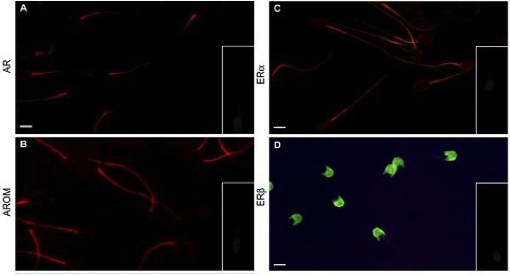
Product Images
bb1a4310-309a-4968-96f5-105f54eadd53.png
Clone H4 used to detect aromatase in pig sperm by Immunofluorescence. …B) P450arom red brilliant light in the proximal tail of sperm with a diffuse labelling in the distal tail. Source