CRUK0640 T1-R7 TRACERx lung cancer PDX
CRUK0640 T1-R7-PDX: Sample from primary NSCLC tumour collected from a White-European female, with a primary diagnosis of collision LUAD and LUSC (stage 3a), smoker
Contributors
| Inventor | Institute |
|---|---|
| Robert Hynds, David Pearce | CRUK Lung Cancer Centre of Excellence at University College London |
| SKU: | 162243 |
|---|---|
| Product description: | Human non-small cell lung cancer (NSCLC) patient-derived xenograft (PDX) model generated from primary tumour from patient enrolled in the Lung TRACERx study. PDX models are highly valuable in recapitulating patient tumour characteristics. These include more representative intratumour heterogeneity, genomic features, metastatic patterns and drug responses than traditional cell line and animal models. Therefore, PDX models can be used to support accurate disease modelling and preclinical in vivo drug validation studies. This pioneering collection of TRACERx NSCLC PDX models were derived from multiple regions of primary tumours from patients enrolled in the Lung TRACERx study. This approach significantly increased PDX engraftment success and these models provide valuable insights into how well PDX models represent the intratumour heterogeneity of source patient tumours. |
| Alternate name: | CRUK0640_PDX_T1-R7 |
| Cat. #: | 162243 |
|---|---|
| Cancer types: | Lung cancer |
| Cancer Subtype: | NSCLC Other: Collision LUAD and LUSC |
| Gender: | Female |
| Age, y.o.: | 60 |
| Cancer Stage or Grade: | 3a |
| Biopsy Site: | Primary lung resection |
| Patient ethnicity: | White-European |
| Treatment History: | Naive |
| Primary citation: | Hynds R.E. et al., Nature Communications 15, 4653 (2024). PMID: 38821942 |
| Initial handling information: | Primary NSCLC tumour material was minced and injected subcutaneously in the flank of male NSG mice in growth factor reduced matrigel. |
|---|---|
| Additional notes: | Additional information on PDX model establishment and characterisation can be found in the Product Information Sheet. |
| Mice Passaged: | Yes |
|---|---|
| Engraftment Site: | Subcutaneous (flank) |
| Sample Type: | Minced tumour |
| Host Strain: | NOD scid gamma (NSG) mice |
| Production details: | Primary NSCLC tumour material was minced and injected subcutaneously in the flank of male NSG mice in growth factor reduced matrigel. To prepare frozen samples for injection, the sample cryovial was warmed in a 37°C water bath until just thawed. The whole sample was then transferred into a sterile 1.5 ml centrifuge tube and topped up with transport medium. The sample was centrifuged at 300 x g for 5 minutes and the supernatant was removed. The sample was then washed with transport medium. If required, any large pieces of tissue were collected and finely minced with a scalpel to ensure they could pass through the needle. The sample was then centrifuged again and gently resuspended in ice-cold Matrigel, and kept on ice before subcutaneous injection. When tumours reached 1.5 cm3 in volume (calculated as 0.5 x length x width2), tumours were aseptically collected and reimplanted into new mice or cryopreserved and banked. |
| References: |
Hynds R.E. et al., Nature Communications 15, 4653 (2024). PMID: 38821942 Jamal-Hanjani M. et al.,PLoS Biol.12, e1001906 (2014). PMID: 25003528 |
|---|
Images
View Gallery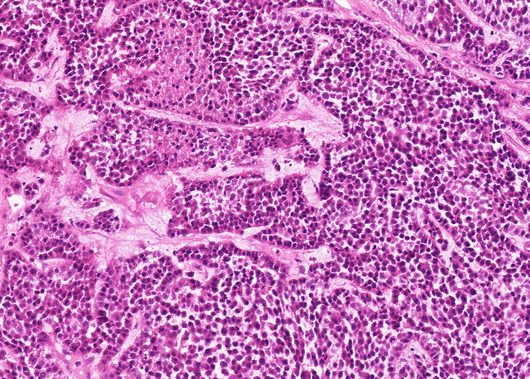
Product Images
CRUK0640 T1-R7 TRACERx lung cancer PDX_P0_hematoxylin and eosin stained image
Representative example of haematoxylin and eosin staining of CRUK0640 T1-R7 TRACERx lung cancer PDX model at early P0 passage.