T47D/TR-1 Cell Line
A tamoxifen-resistant human breast cancer model used to study endocrine resistance mechanisms, hormone signalling pathways, and therapeutic development. Save 30% on this cell line this autumn. Use code ACA26CELL at checkout.
Contributors
| Inventor | Institute |
|---|---|
| Anne Lykkesfeldt | Danish Cancer Society |
| SKU: | 152108 |
|---|---|
| Product description: | The T47D/TR-1 cell line is a tamoxifen-resistant derivative of the T47D human breast cancer cell line. It was developed by adapting T47D/S2 cells to 4-hydroxytamoxifen under reduced serum conditions to induce tamoxifen resistance. This adaptation results in a model that closely mimics the clinical progression of tamoxifen resistance in hormone receptor-positive breast cancer. T47D/TR-1 cells maintain oestrogen receptor alpha (ERα) and progesterone receptor (PR) expression, characteristic of luminal A subtype breast cancer. They exhibit a polygonal epithelial morphology and are adherent in culture. The cell line serves as a valuable tool for investigating the molecular mechanisms underlying tamoxifen resistance, facilitating the identification of potential therapeutic targets and strategies to overcome resistance. |
| Conditional: | Yes |
| Production details: | Human breast cancer cell line derived from T47D/S2 cells by long-term culture in the presence of 4-hydroxytamoxifen under reduced serum conditions to induce tamoxifen resistance. |
| Cellosaurus ID: | CVCL_1D36 |
| Parental cell line: | T47D/S2 |
| Disease: | Cancer |
| Related tools: | T47D/S2 Cell Line |
| Cat. #: | 152108 |
|---|---|
| Tool sub type: | Continuous |
| Unit size: | 1×10^6 cells / vial |
| Cancer types: | Breast cancer |
| Research Fields: | Cancer; Drug development |
| Organism: | Human |
| Tissue: | Breast |
| Model: | Cancer cell line |
| Growth properties: | Adherent |
| Cancer Types In Detail: | Breast carcinoma;Tamoxifen resistant |
| Primary citation: | Kirkegaard et al. 2014. Cancer Lett. 344(1):90-100. PMID: 24513268. |
| Format: | Frozen |
|---|---|
| Storage conditions: | Liquid Nitrogen |
| Shipping conditions: | Dry ice |
| Growth medium: | Phenol red free RPMI 1640 + 2% FCS + glutamax + 8ug Insulin/ml + 1 uM tamoxifen. Fetal Calf Serum (FCS) typically contains less estrogen than Fetal Bovine Serum (FBS) and is the preferred supplement for this cell line. |
| Subculture routine: | Following thawing and counting, dilute the cell suspension with sufficient medium and distribute 5 mL each into T25 flasks to achieve a seeding density of 1.8 – 2.0 x 10^4 / cm2. Place in 37°C, 5% CO₂ incubator. Change medium after 24 hours to remove residual DMSO and then every 2-3 days. Subculture routine: Split 1:7 weekly (slow growing cell line) with Trypsin-EDTA for detachment at 37 °C for 5 minutes. Please also see detailed protocol within the Product Datasheet in the Documentation section below. |
| Temperature: | 37° C |
| Atmosphere: | 5% CO2 |
| Storage medium: | 10% DMSO in FCS |
| Mycoplasma free: | Yes |
| Biosafety level: | 1 |
| References: |
Larsen et al. 2015. PLoS One. 10(2):e0118346. PMID: 25706943. Larsen et al. 2015. BMC Cancer. 15(1):1-15. PMID: 25885472. Thrane et al. 2014. Oncogene. 34(32):4199-4210. PMID: 25362855. Kirkegaard et al. 2014. Cancer Lett. 344(1):90-100. PMID: 24513268. |
|---|
Images
View Gallery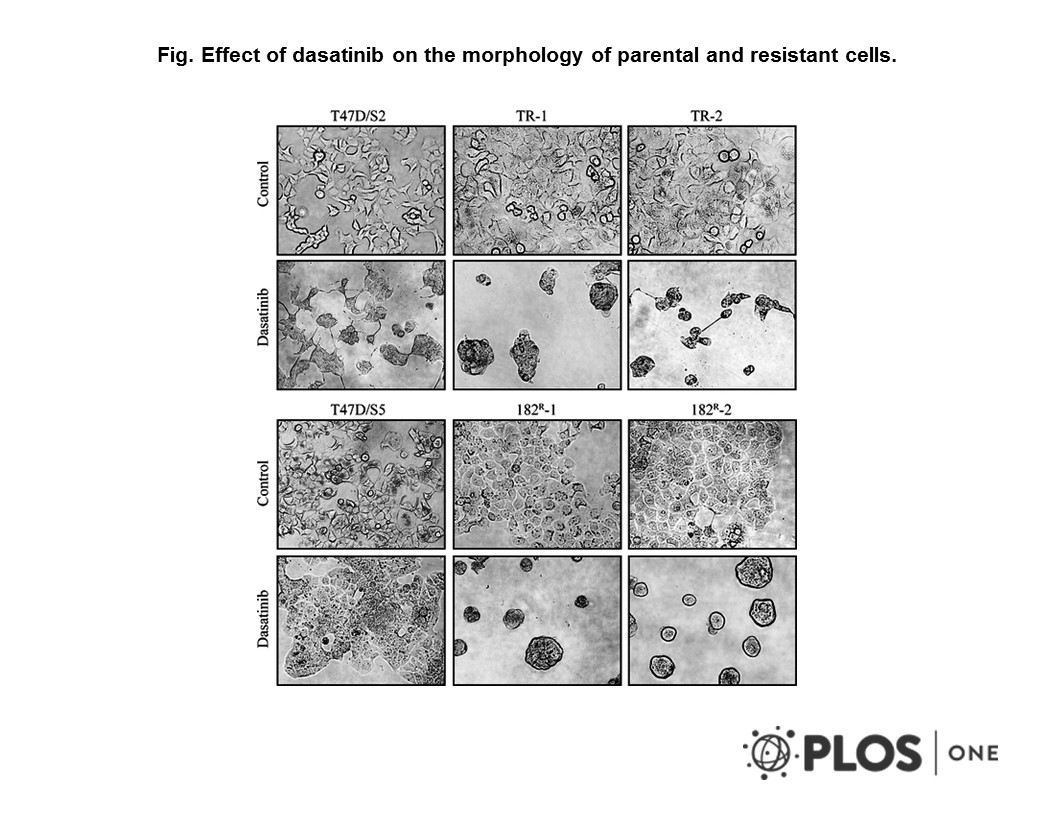
Product Images
T47D/TR-1 cells
Representative pictures of sensitive parental (T47D/S2 and T47D/S5); tamoxifen (TR-1 and TR-1) and fulvestrant (182R-1 and 182R-2) resistant cell lines treated for five days with dasatinib or DMSO (control). Adapted from Larsen et al. 2015. PLoS One. 10(2):e0118346. PMID: 25706943.
Related Tools for Cell lines
| Cat. # | Tool Name | |||||||||||||
|---|---|---|---|---|---|---|---|---|---|---|---|---|---|---|
| 152109 | T47D/S2 Cell Line |
Key Info
T47D/S2 Cell Line
|
View Tool | |||||||||||