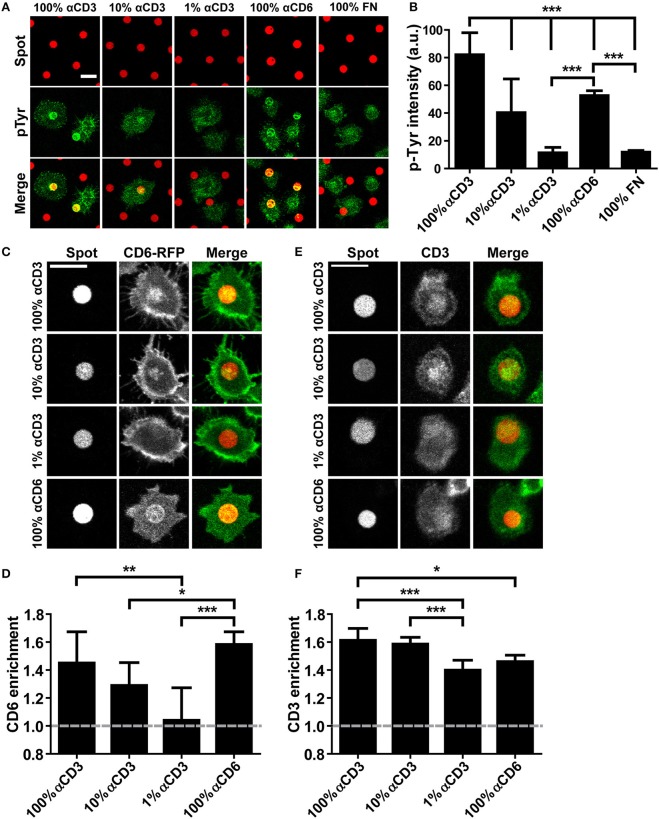
Activation of the T cell receptor (TCR) on the T cell through ligation with antigen-MHC complex of an antigen-presenting cell (APC) is an essential process in the activation of T cells and induction of the subsequent adaptive immune response. Upon activation, the TCR, together with its associated co-receptor CD3 complex, assembles in signaling microclusters that are transported to the center of the organizational structure at the T cell-APC interface termed the immunological synapse (IS). During IS formation, local cell surface receptors and associated intracellular molecules are reorganized, ultimately creating the typical bull’s eye-shaped pattern of the IS. CD6 is a surface glycoprotein receptor, which has been previously shown to associate with CD3 and co-localize to the center of the IS in static conditions or stable T cell-APC contacts.
Alternate name:
CD6
Conditional:
No
Production details:
Jurkat cell lines stably expressing CD6-RFP were obtained by electroporation using the Neon Transfection System for Electroporation (Invitrogen) according to the manufacturer’s guidelines. Shortly, 5*105 Jurkat cells were transfected at 1325 Volt (10 ms, 3 pulses) with 3 ÄÂÄ?g of DNA in 100 ÄÂÄ?l Resuspension buffer. After transfection cells were seeded in 2 ml of 1640 RPMI with 10% FCS and 1% U-glut. Antibiotics were added after 3 h. Stable cell lines were sorted on RFP expression on…
Parental cell line:
Jurkat E6.1
Disease:
Cancer
Cat. #:
160713
Tool sub type:
Continuous
Unit size:
1×10^6 cells / vial
Cancer types:
Blood cancer
Research Fields:
Cancer; Cell biology; Cell signaling and signal transduction; Immunology
Organism:
Human
Tissue:
Blood
Cancer Types In Detail:
Acute T cell Leukemia
Format:
Frozen
Shipping conditions:
Dry ice
Growth medium:
1640 RPMI (PAA) supplemented with 10% Fetal Calf Serum, 1 mM Ultra-glutamine and antibiotics (100 U/ml penicillin, 100 ?g/ml streptomycin and 0.25 ?g/ml amphotericin B). 500 ng/ml geneticin.
References:
Meddens et al. 2018. Front Immunol. 9:2333. PMID: 30356797.
Please ensure you use your organisation email address rather than personal where possible, as this helps us locate your organisation in our system faster.
Please note we may take up to three days to respond to your enquiry.
CancerTools.org uses the contact information provided to respond to you about our research tools and service. For more information please review our privacy policy.