A2780 PTX(16) resistant cell line
Contributors
| Inventor | Institute |
|---|---|
| Jolanta Szenajch ; Luiza Handschuh ; Aleksandra Świercz ; Michał Góralski ; Alicja Szabelska-Beręsewicz; Joanna Zyprych-Walczak ; Idzi Siatkowski | Military Institute of Medicine – National Research Institute |
| SKU: | 160731 |
|---|---|
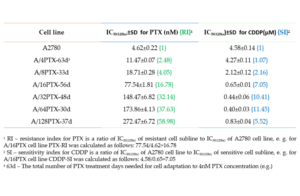
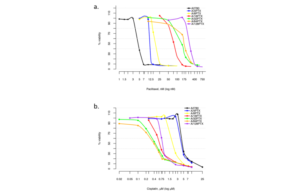
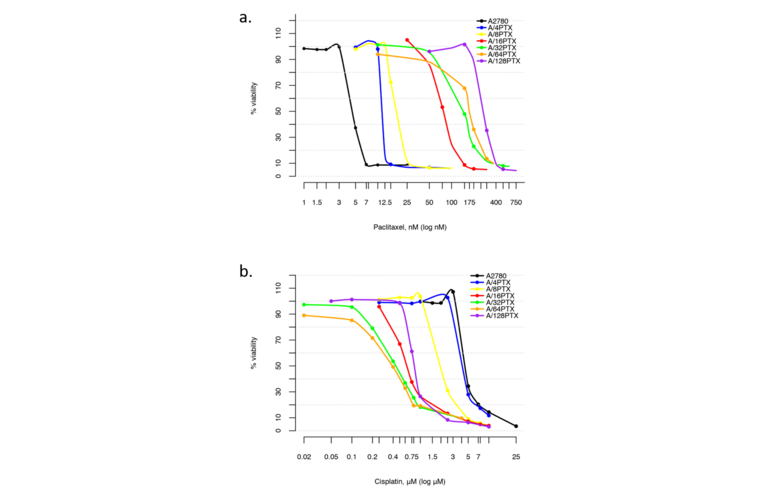
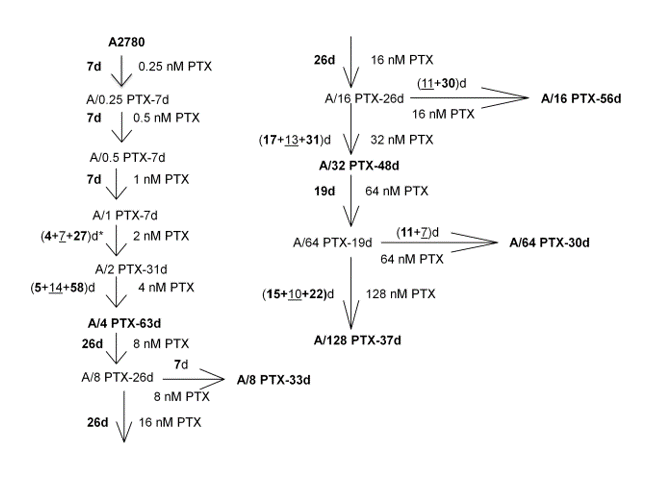
| Product description: | The paclitaxel (PTX) resistant A2780 PTX (16) cell line with collateral sensitivity to cisplatin (CDDP) (inverse resistance) has been developed by continuous growing of A2780 PTX (8) cell line (cat. no 160730) in 16 nM PTX concentration (for details see Fig. 1). The half maximal inhibitory concentration (IC50) for PTX is about seventeen times as high the IC50 for A2780, whereas for CDDP it is about seven times lower (for details see Tab. 1). PTX and CDDP are standard chemotherapeutic drugs used in the treatment of ovarian cancer and acquired resistance to them remains a major obstacle in therapy. The trend of developing the inverse resistance is dominant in clinical practice, therefore A2780 PTX (16) cell line with other sublines of the series (see Notes for details) can be used as a primary tool for deciphering the molecular and cellular mechanisms of drug resistance in ovarian cancer. This cell line was generated as part of a series of isogenic ovarian cancer lines with gradually changing inverse resistance to PTX (resistant) and CDDP (sensitive); see A2780 PTX (4) Cat no:160729, A2780 PTX (8) Cat no:160730, A2780 PTX (32) Cat no:160732, A2780 PTX (64) Cat no:160733, and A2780 PTX (128) Cat no:160734 for the others (see Tab. 1 and Fig. 2 for details). Transcriptomes of six sublines were sequenced and the mRNA dataset was deposited under Gene Expression Omnibus Accession No GSE159791.Patent number: 233178 |
| Production details: | Split sub-confluent cultures (70-80%) seeding at 4 x 1000 (tolerated range: 1 x 1000 to 1 x 10 0000) cells/cm2 using TrypLE ExpressTM, 5% CO2, 37oC. Culture cells without drug until they have been fully adhered (after 24 h). |
| Cellosaurus ID: | CVCL_C0D8 |
| Parental cell line: | A2780 |
| Disease: | Cancer |
| Cat. #: | 160731 |
|---|---|
| Tool sub type: | Continuous |
| Unit size: | 1×10^6 cells / vial |
| Cancer types: | Ovarian cancer |
| Research Fields: | Cancer; Drug development |
| Organism: | Human |
| Tissue: | Ovary |
| Model: | Tumour line |
| Growth properties: | Adherent |
| Cancer Types In Detail: | Ovarian |
| Format: | Frozen |
|---|---|
| Shipping conditions: | Dry ice |
| Growth medium: | RPMI 1640 medium + 2mM L-alanine-L-glutamine (GlutaMAXTM) + 5% heat-inactivated Foetal Bovine Serum (FBS) , at 37?°C and 5% CO2. To keep the stability of resistance profile not using antibiotics and antimycotics is recommended. Cells should be cultured without PTX (up to 10 days) to avoid the resistance escalation. After this time the maintenance treatment with 16 nM PTX for one passage is recommended. |
| References: |
Szenajch et al. 2020. Int. J. Mol. Sci. 21(23): 9218. PMID: 33287223 |
|---|
Images
View Gallery

Product Images
a01bb5d7-14b9-493f-a1e0-f1e464f24829
eb58d6ad-724c-47f6-a9ec-770ba21b66e9
cdf32af2-7f07-4569-8158-a36876371893
15ea4e20-cc5f-4e9d-afcb-80da03786cdd
Figure 1. The family tree of A2780 cell sublines with acquired resistance to PTX. A2780 parental cell line and six sublines; chosen for further studies; are bolded. The schedule of PTX treatment for each cell line is described as e.g. (4+7+27)d* – 4 days of 2 nM PTX treatment; 7 days of recovery and 27 days of 2 nM PTX retreatment; totally 31 days of drug treatment were needed for cell adaptation to 2 nM PTX concentration. Reprinted from Szenajch J. et al. 2020. Int. J. Mol. Sci. 21(23)