Anti-pan-late cornified envelope 3, pan-LCE3 [7]
Deletion of LCE3B and LCE3C proteins has been shown to be a significant risk factor in psoriasis.
Contributors
| Inventor | Institute |
|---|---|
| Joost Schalkwijk | Radboud University Medical Center (UMC) |
| SKU: | 160445 |
|---|---|
| Product description: | The LCE3 proteins are structural components of the cornified envelope of the stratum corneum and may be involved in innate cutaneous host defence. They have been shown to posses antibacterial (gram positive and negative, aerobic and anaerobic species) properties. During inflammation they have been shown to be involved in skin repair (PMID: 28634035). Deletion of LCE3B and LCE3C proteins have been shown to be a significant risk factor in psoriasis. |
| Alternate name: | Late envelope protein 16, Small proline-rich-like epidermal differentiation complex protein 6A, Small proline-rich-like epidermal differentiation complex protein 6B |
| Conjugation: | Unconjugated |
| Immunogen: | Late cornified envelope protein 3B |
| Myeloma used: | Sp2/0 |
| Cat. #: | 160445 |
|---|---|
| Tool sub type: | Primary antibody |
| Unit size: | 100 ug |
| Research Fields: | Cell biology; Immunology |
| Application: | ELISA ; IHC ; IF |
| Target: | Late cornified envelope (LCE) protein 3 |
| Reactivity: | Human |
| Host: | Mouse |
| Class: | Monoclonal |
| Target background: | The LCE3 proteins are structural components of the cornified envelope of the stratum corneum and may be involved in innate cutaneous host defense. They ahve been shown to posses antibacterial (gram positive and negative, aerobic and anearobic speacies) properties. During inflammation they haev been shown to be involved in skin repair (PMID: 28634035). Deletion of LCE3B and LCE3C proteins has been shown to be a significant risk factor in psoriasis. |
|---|
| Format: | Liquid |
|---|---|
| Shipping conditions: | Dry ice |
| References: |
Niehues et al. 2016. Br J Dermatol. 174(4):795-802. PMID: 26556599. |
|---|
Images
View Gallery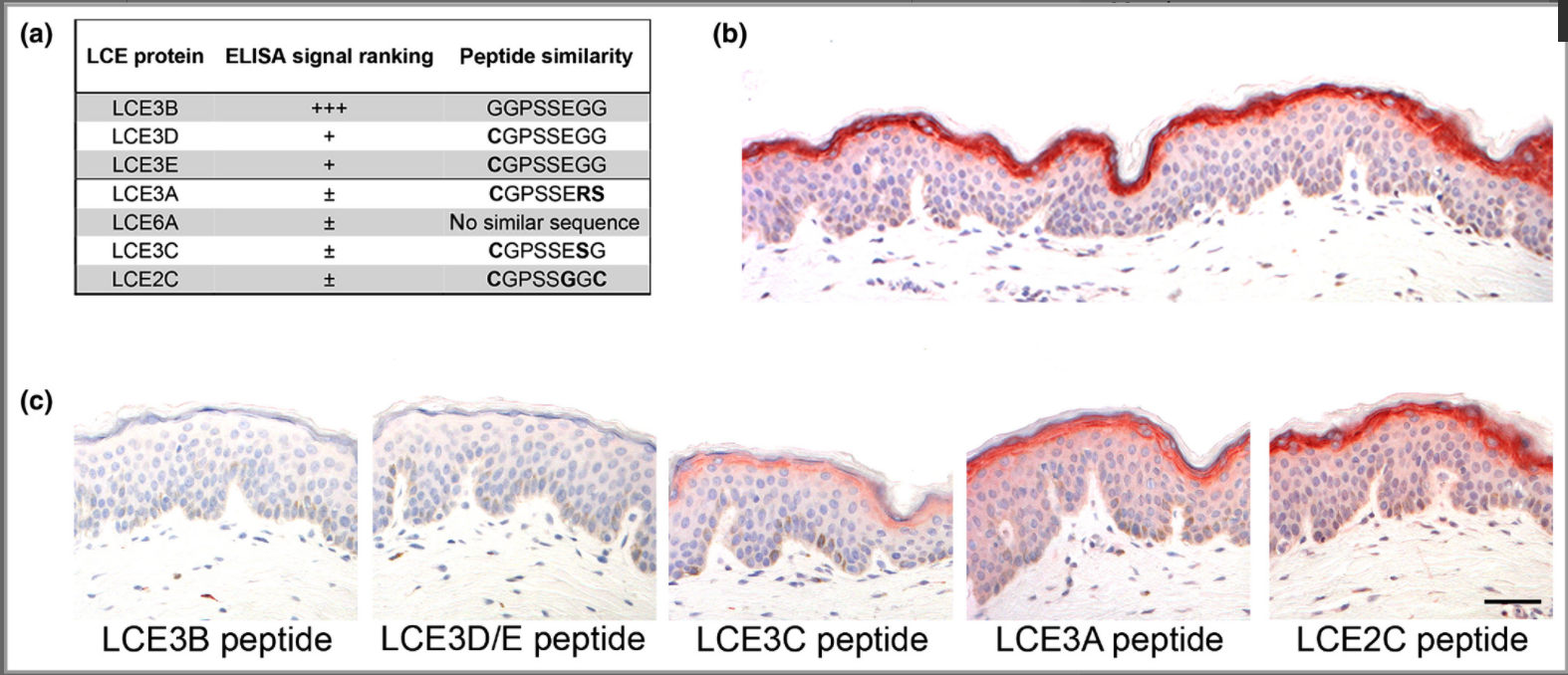
Product Images
5928e4a3-d30b-49a6-94da-e60e36c7214b.png
Late cornified envelope (LCE)3 protein peptide recognition pattern. (a) Affinity data of anti?LCE3 monoclonal antibody against different LCE3 proteins based on enzyme?linked immunosorbent assay (ELISA) analysis; and comparison of the epitope sequences in the LCE3 members. The LCE3B peptide was used for mouse immunization. (b) Immunohistochemical staining of LCE3 proteins in normal human epidermis with the developed anti?LCE3 monoclonal antibody. The picture is representative for the expression in three different skin biopsies. (c) Staining of LCE3 proteins in normal human skin after competition with our anti?LCE3 antibody and LCE peptides. Scale bar = 100 ?m.