Anti-EBV Latent Membrane Protein 1 [LMPO24]
Exclusive toolMonoclonal antibody which can be used to investigate EBV latency and EBV-associated malignant cells.
Contributors
| Inventor | Institute |
|---|---|
| Martin Rowe | University of Birmingham |
| SKU: | 152632 |
|---|---|
| Product description: | Monoclonal antibody which can be used to investigate EBV latency and EBV-associated malignant cells. Background and Research Application EBV is a human herpesvirus that establishes a life-long persistence in the host. The virus infects the vast majority of the world’s adult population and is well known for its association with a broad spectrum of benign and malignant diseases. These include infectious mononucleosis, Burkitt’s lymphoma, nasopharyngeal carcinoma, and is causally associated with lymphoid and epithelial malignancies, including post-transplant lymphoproliferative disorders, Hodgkin’s disease, anaplastic nasopharyngeal carcinoma and gastric carcinomas. This antibody is specific for latent membrane protein 1 (LMP1) of Epstein-Barr virus (EBV). LMP1 is a transforming protein that affects multiple cell signalling pathways and contributes to EBV-associated oncogenesis. This protein can be expressed in some states of EBV latency, and significant induction of full-length LMP1 is also observed frequently during virus reactivation into the lytic cycle. LMP1 is critical for EBV-infected cell activation, adhesion and survival, and is usually expressed in the malignant cells. |
| Conjugation: | Unconjugated |
| Isotype: | IgG1 kappa |
| Immunogen: | Purified plasma membranes from LMP1 expressing insect cells infected with a recombinant LMP1 baculovirus |
| Immunogen Uniprot ID: | P03230 |
| Cat. #: | 152632 |
|---|---|
| Tool sub type: | Primary antibody |
| Unit size: | 100 ug |
| Application: | FACS ; IHC |
| Target: | Epstein-Barr Virus, Latent Membrane Protein 1 (EBV-LMP1) |
| Reactivity: | Virus |
| Clone: | LMPO24 |
| Host: | Mouse |
| Class: | Monoclonal |
| Target background: | Monoclonal antibody which can be used to investigate EBV latency and EBV-associated malignant cells. Background and Research Application EBV is a human herpesvirus that establishes a life-long persistence in the host. The virus infects the vast majority of the world’s adult population and is well known for its association with a broad spectrum of benign and malignant diseases. These include infectious mononucleosis, Burkitt’s lymphoma, nasopharyngeal carcinoma, and is causally associated with lymphoid and epithelial malignancies, including post-transplant lymphoproliferative disorders, Hodgkin’s disease, anaplastic nasopharyngeal carcinoma and gastric carcinomas. This antibody is specific for latent membrane protein 1 (LMP1) of Epstein-Barr virus (EBV). LMP1 is a transforming protein that affects multiple cell signalling pathways and contributes to EBV-associated oncogenesis. This protein can be expressed in some states of EBV latency, and significant induction of full-length LMP1 is also observed frequently during virus reactivation into the lytic cycle. LMP1 is critical for EBV-infected cell activation, adhesion and survival, and is usually expressed in the malignant cells. |
|---|
| Format: | Liquid |
|---|---|
| Concentration: | 1 mg/ml |
| Storage buffer: | PBS with 0.02% azide |
| Storage conditions: | Store at -20° C frozen. Avoid repeated freeze / thaw cycles |
| Shipping conditions: | Dry ice |
| References: |
Niedobitek et al. 1995. Blood. 86(2):659-65. PMID: 7605996. Heterogeneous expression of Epstein-Barr virus latent proteins in endemic Burkitt's lymphoma. |
|---|
Images
View Gallery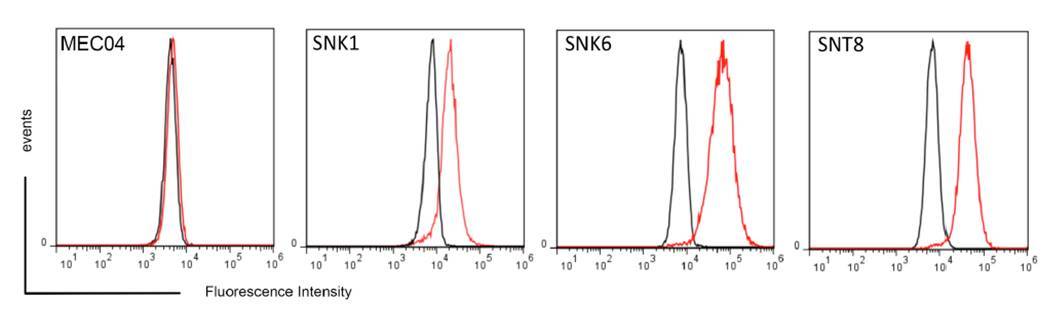
Product Images
21b9c272-b88b-4cea-8d2d-7d5ecd36fa48.jpg
Intracellular staining of LMP1 using LMPO24 antibody. NK and T cell lines were fixed and permeabilised with an EBiosciences kit (Cat 88-8824-00) then stained with LMPO24 monoclonal antibody; followed by detection with Alexa Fluor 488 conjugated anti-mouse IgG antibody and analysis by flow cytometry. The histograms show negative control fluorescence staining (black lines) and LMPO24 staining (red lines). MEC04; SNK1; SNK6 and SNT8 are EBV positive tumour cell lines derived from patients with nasal NK/T cell lymphomas. MEC04; SNK1 and SNK6 are NK cell lines; while SNT8 is a T cell line. MEC04 lacks LMP1 expression; SNK1 expresses weak to moderate levels of LMP1; whilst SNK6 and SNT8 express high levels of LMP1.
Related Tools for Antibodies
| Cat. # | Tool Name | |||||||||||||||
|---|---|---|---|---|---|---|---|---|---|---|---|---|---|---|---|---|
| 151471 | Anti-EBV Latent Membrane Protein 1 [CS 1-4] |
Key Info
Anti-EBV Latent Membrane Protein 1 [CS 1-4]
|
View Tool | |||||||||||||