Plasmax™ is a next-generation cell culture medium that closely mimics the nutritional u0026 metabolic profile of human plasma
Cell culture media is a critical component of cell-based assays, but its contribution to results is often overlooked. Traditional synthetic cell culture media, like Dulbecco’s Modified Eagle Medium (DMEM), were formulated over 50 years ago to enable continuous cell culture by supplying excessive levels of a few nutrients. However, these formulations do not accurately replicate the in vivo metabolic cellular environment. This can often yield results that do not translate in vivo.
To address this challenge, the research team at the Beatson Institute for Cancer Research, led by Dr. Saverio Tardito, developed Plasmax™ – a cell culture medium that better reflects human physiological conditions, to study cell metabolism in different tumour types. This complete, ready-to-use, chemically defined medium comprises of 80 optimised components, utilised by cells in vivo, at concentrations present in human plasma.

(MedUni Wien/feelimage)
Meet Dr. Saverio Tardito – the inventor of Plasmax™
CancerTools.org are proud to have partnered with Dr. Saverio Tardito to make Plasmax™ cell culture medium easily accessible to researchers worldwide, both in academia and industry.
Dr. Saverio Tardito was formerly the group leader of the oncometabolism research group at the Cancer Research UK Glasgow Beatson Institute and is now an Assistant Professor at Medical University of Vienna.
We are excited by the wide-reaching potential this innovative medium holds for various scientific fields including oncology.
Saverio has recently investigated a whole-genome CRISPR-based screen comparing gene essentiality in triple negative breast cancer cells cultured in DMEM vs Plasmax™ in collaboration with the CRUK-Astra Zeneca Functional Genomics Centre. Read more here.
Read his original publication on Plasmax™ here: Improving the metabolic fidelity of cancer models with a physiological cell culture medium.
Plasmax™ – Where cells thrive
Benefits of Plasmax™ for cell culture
| Physiologically relevant | Recapitulates in vivo tumour metabiome | Enhanced colony formation | Ready-to-use medium |
|---|---|---|---|
| Optimised to closely reflect the in vivo metabolic and nutritional profile of human plasma | Cancer cell lines cultured in PlasmaxTM exhibit metabolic profiles that more closely resemble orthotopic tumour xenografts | Growth-enabling trace elements prevent ferroptosis-induced cell death & promote colony formation | A ready-to-use medium, available in both regular and glucose-free formulations, that streamlines your workflow by eliminating the need for complex preparation steps |
| Generate more translatable data, in comparison to traditional media like DMEM | Enhance the biological relevance of in vitro cancer models, compared to traditional media like DMEM | Faster cell proliferation compared to traditional media like DMEM | Convenient and ready-to-use, allowing you to focus on your experiments |
Physiologically relevant formulation – 80 optimised components at concentrations found in human plasma
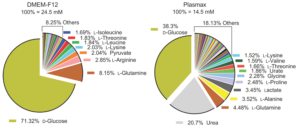
Plasmax™ formulation includes:
- 20 proteinogenic amino acids
- 7 non-proteinogenic amino acids
- 5 amino acid derivatives
- 7 inorganic salts
- 7 trace elements
- 11 vitamins
- 23 other components
Traditional media are limited by containing only a selected number of nutrients. DMEM-F12 relies on glucose and glutamine as >75% of its nutrients. Plasmax™ cell culture medium provides a more balanced profile, with these components making up less than 50% of its composition. Additionally, Plasmax™ includes 35% more components, found in human plasma, but that are missing from standard media (Figure 1).
The result of this is a more physiologically relevant cell culture medium. Plasmax™ enables nutrient exchange that better reflects the in vivo environment than DMEM-F12(1) and prevents pseudo-hypoxia in cancer cells, unlike traditional media such as DMEM-F12(1).
Plasmax™ vs. traditional cell culture media
Plasmax™ improves the metabolic fidelity and biological relevance of in vitro cancer models
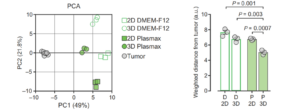
- Metabolic profiles of cancer cell lines cultured in Plasmax™ are distinct to those obtained when cultured in DMEM-F12(1).
- 2D and 3D CAL-120 cancer cell cultures grown in Plasmax™ were found to have metabolic profiles closer to those of orthotopic tumour xenografts, compared to DMEM-F12 (Figure 2).
Plasmax™ boosts cell growth & colony formation
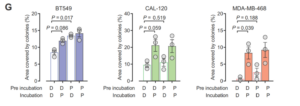
- Growth-enhancing trace elements within Plasmax™ boost the antioxidant capacity of cells and promote colony growth, by preventing ferroptosis-induced cell death(1).
- Plasmax™ increased the overall growth and colony forming capacity of three low-density plated triple negative breast cancer (TNBC) cell lines, BT549, CAL-120, and MDA-MB-468, compared to DMEM-F12 (Figure 3).
What our customers say about Plasmax™ vs. DMEM
“In the future, whatever metabolism related work I do, I’ll make sure to compare DMEM to Plasmax™ to ensure that the nutrient profile is not effecting the certain phenotype that I’m seeing. It doesn’t hurt – if you are already doing one experiment in one certain media condition, just make another plate with Plasmax™ for side-by-side comparison. So, I actually don’t see why one wouldn’t try it. Especially before you jump into big in vivo experiments, which involve a lot of time and money. Using physiologically relevant media is a time saver and will make you more confident in your data.”
Sunada Khadka – Postdoctoral Fellow, MD Anderson Cancer Center.
Plasmax™ has been validated across multiple in vitro cancer models
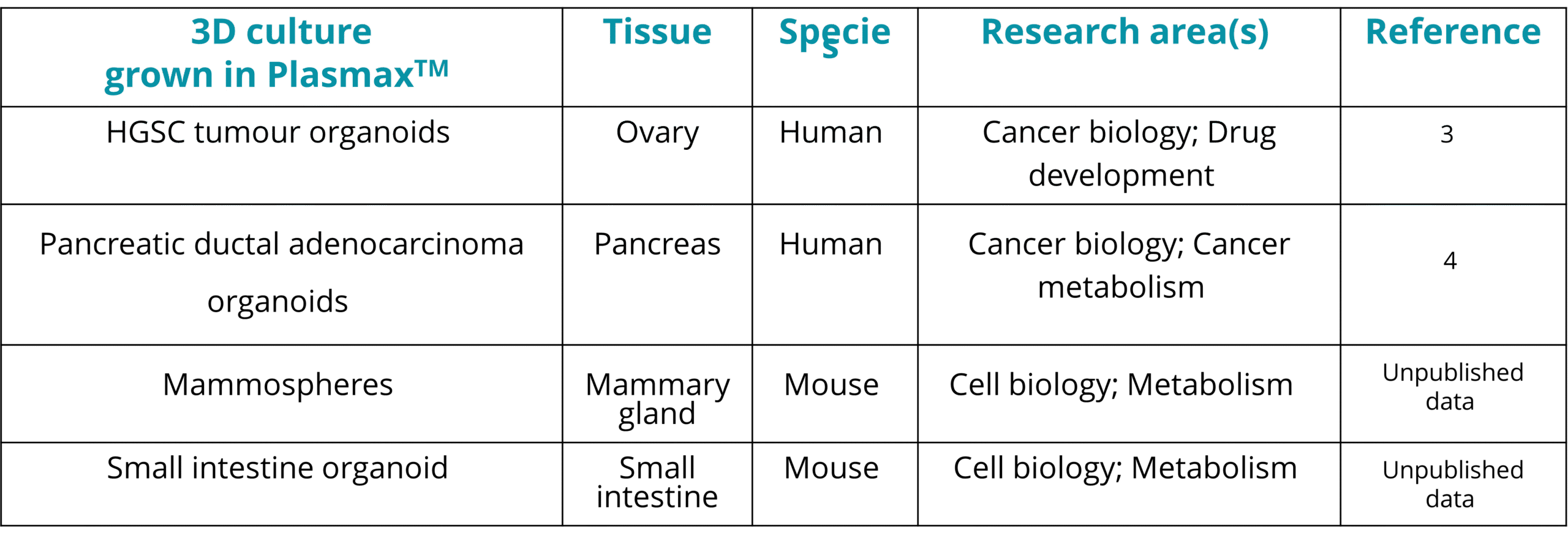
Plasmax™ is highly cited and has been shown to work across a broad range of in vitro cancer models including cell lines and organoids, across multiple cancer types (Tables 1 & 2).
Key publications highlight its compatibility with cell lines from key cancer types like breast, lung, and brain, in key research areas such as cancer biology and metabolism.
Table 1: Primary and established cell lines successfully validated for viability and growth in Plasmax™ cell culture medium under standard conditions.
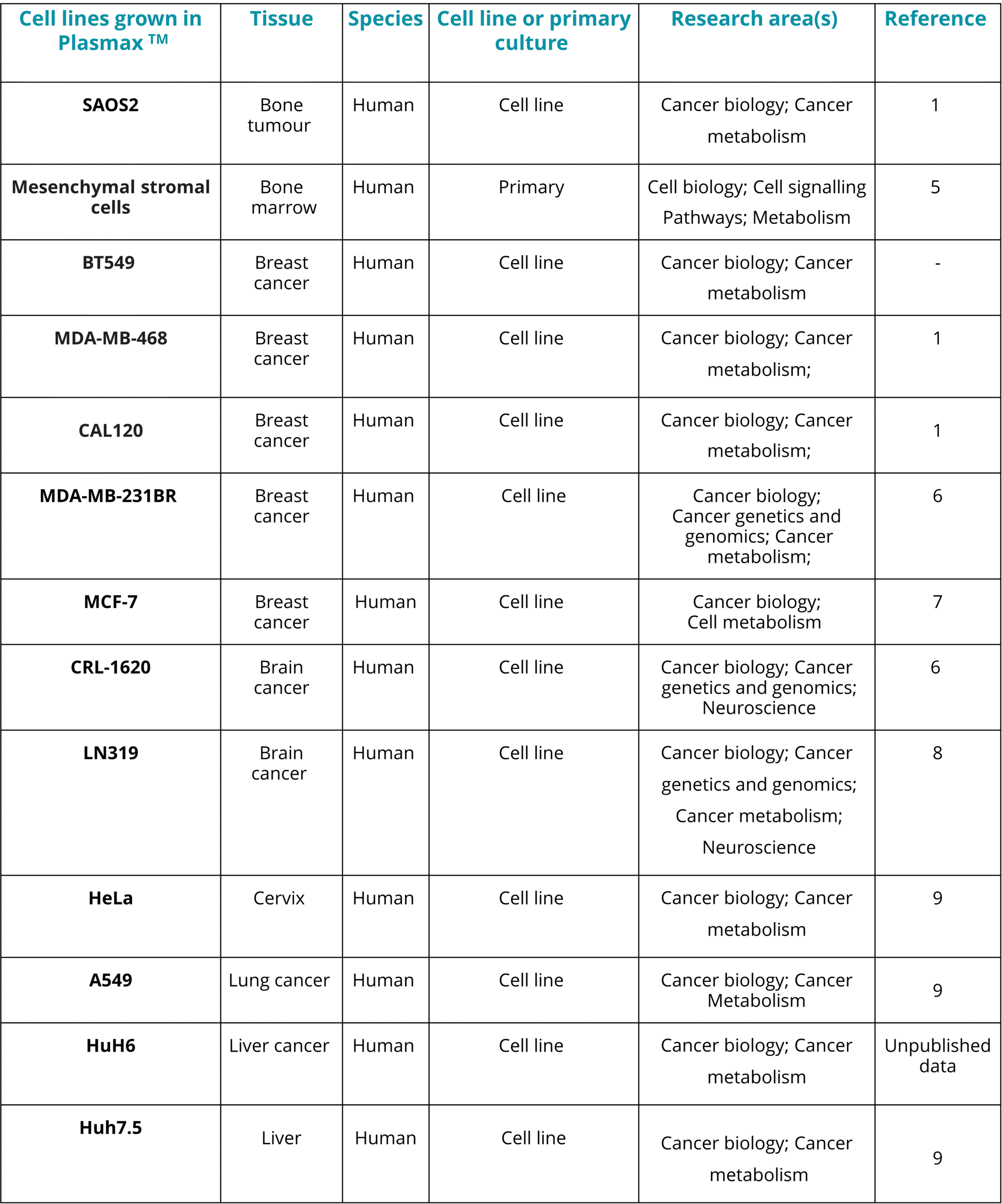
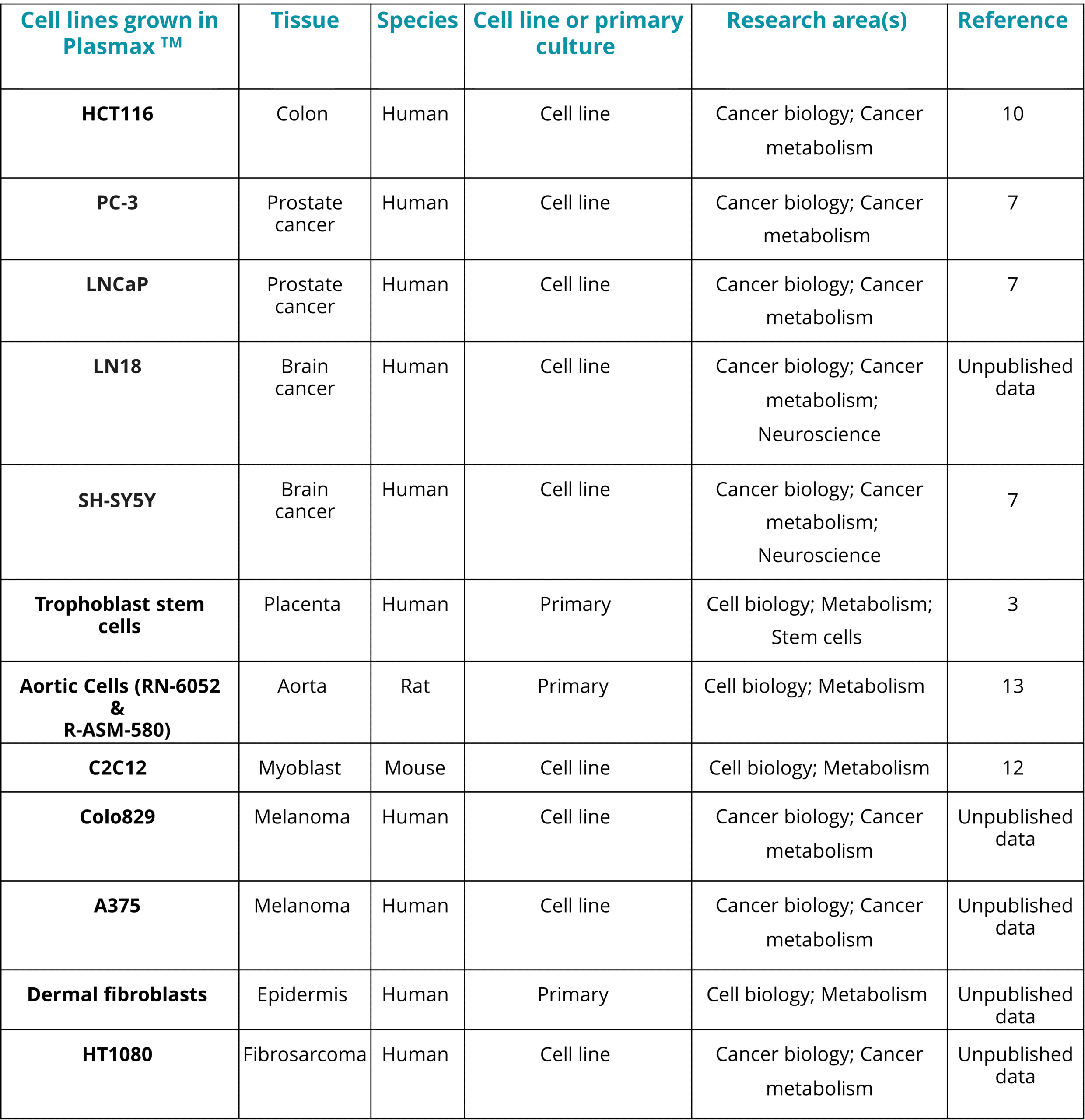
Table 2: 3D cultures successfully validated for viability and growth in Plasmax™ cell culture medium under standard conditions.
Glucose-free Plasmax™

We now offer a glucose-free version of Plasmax™ which while eliminating glucose, preserves the original optimised, physiologically relevant composition of Plasmax™.
Glucose-free Plasmax™ can be used to support glucose starvation studies, tumour microenvironment and cancer metabolism research, and studies involving the metabolic tracing of glucose.
These studies can help uncover mechanisms underlying key cancer cell metabolism and glucose utilisation pathways.
Access PlasmaxTM, Glucose-free
Resources
- Application note – Advancing cancer cell biology with a physiologically relevant cell culture medium: Plasmax™
- Case study – Plasmax™ vs DMEM the impact of physiologically relevant cell culture media
- Formulation – Plasmax™
- Cell culture media FAQs
- Technical support