Those working in drug discovery know there is rarely a linear path from biological insight to therapeutic development. The development of PARG inhibitors – from an emerging idea around a seemingly undruggable target to a growing area of cancer research – illustrates how high-quality chemical probes, collaboration, and robust validation can help navigate that complexity. Together with Dr. Allan Jordan, we explore how research tools, accessibility and scientific rigour can accelerate discovery and ultimately deliver more tomorrows for patients worldwide.

From emerging biology to therapeutic opportunity
Dr. Allan Jordan, Senior Vice President of Oncology Drug Discovery at Sygnature Discovery, has spent his career translating emerging biology into therapeutic opportunities. His work spans oncology programmes, targeted protein degraders, antibody-drug conjugates and other novel therapeutic modalities. Yet one project in particular continues to shape the field: the development of some of the first high-quality inhibitors of Poly(ADP-ribose) glycohydrolase, better known as PARG.
The foundations of that work were laid during Allan’s nine years as Head of Chemistry at the Cancer Research UK Manchester Institute Drug Discovery Unit. There, he and his colleagues engaged in a unique position in the drug discovery ecosystem: translating emerging, CRUK-funded biological discoveries into potential therapies.
Unlike many industrial drug discovery programs that focus on validated targets, the Manchester team deliberately pursued higher-risk opportunities emerging from academic research. Their role was to identify promising biological targets, determine whether they represented genuine therapeutic opportunity, and generate the tools needed to answer those questions. This often meant working on targets considered too difficult or simply too uncertain for conventional drug discovery investment.
As Allan reflects, uncertainty was simply part of the process.
“There are a lot of failures, there are a lot of missteps. There is a lot of starting off in one direction and then realising for biological or chemical tractability that the target is not going to be prosecutable.”
One programme, however, proved different. What began as an ambitious effort to investigate a difficult and poorly understood target has since helped establish an entirely new area of cancer research.
The challenge of targeting PARG
PARG acts as the counterpart to Poly(ADP-ribose) polymerase (PARP), a family of proteins already well established in cancer therapy through the success of PARP inhibitors. Following DNA damage, PARP enzymes create chains of poly(ADP-ribose) that act as molecular signposts, directing repair machinery to the damaged site. PARG performs the equally important task of removing those signals once repair is ready to proceed (Figure 1).
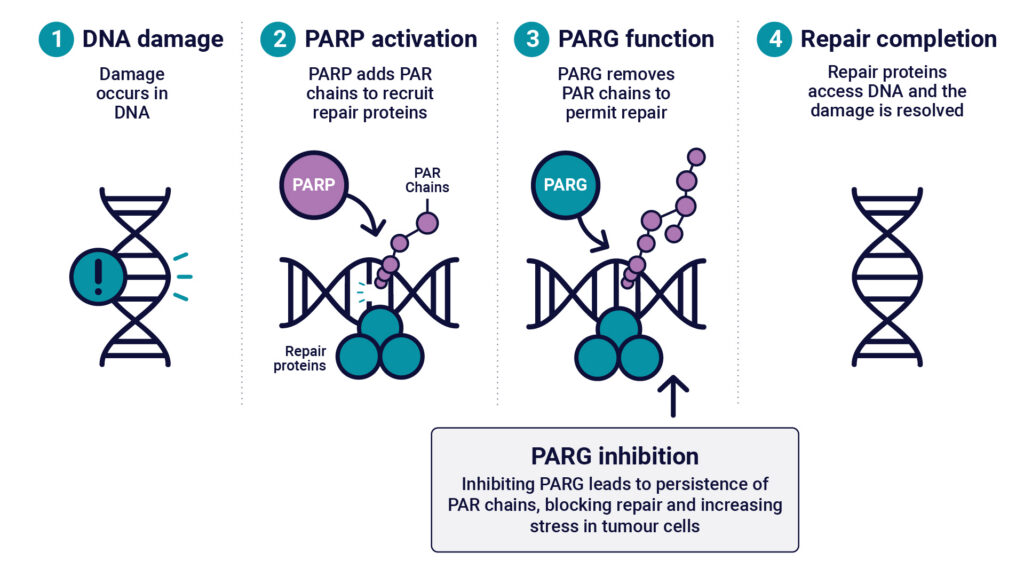
Researchers at the Manchester Institute, and in other institutes, had hypothesised that inhibiting PARG could hinder the tumour cell’s ability to repair DNA damage, particularly in cancers that are already reliant on specific repair pathways. There was also the potential that PARG inhibition might overcome resistance to PARP inhibitors.
Yet there was a problem. At the time, PARG was widely considered undruggable.
“The binding site was a big, open, flat surface,” Allan recalls. “It’s all the things you don’t want when you’re looking for small molecule inhibitors.”
Thus, finding a potent, selective and drug-like inhibitor appeared unlikely. The breakthrough came through a collaboration with AstraZeneca and the discovery of an unexpected feature within the PARG protein.
“What we were able to demonstrate is that there was an unknown cryptic binding site on PARG. This binding site folded itself around our inhibitors rather than being obvious in the structures,” Allan describes.
That hidden pocket transformed the programme.
“That cryptic binding site made PARG druggable. We were able to take a modestly potent, poorly selective and DNA intercalating hit molecule, and develop it into a very selective inhibitor of PARG.”
Why chemical probes matter
Often, decision making in early drug discovery relies on understanding the impact of inhibiting the chosen target. Genetic tools like CRISPR have transformed target validation, but they do not always reflect how a drug’s action will alter cell biology or disease progression.
“Almost all target validation experiments are done with knock-in, knock-out or knock down using RNA or CRISPR genetic engineering tools …very much a sledgehammer approach”, Allan explains. “With a small molecule inhibition approach, you must be able to show that you can copy disease relevant pharmacology with a small molecule. If you don’t have a high-quality tool molecule, you don’t know what that molecule is doing. Is your inhibitor on target and the disease biology is aligned? Or is it that your small molecule has off-target cytotoxicity and just kills cells?”
Allan goes onto explain that this is where validated high-quality chemical tools allow researchers to modulate a target with precision, helping to distinguish genuine biology from experimental artefacts and enabling questions that genetics alone may not answer.
The PARG inhibitors developed by the Manchester team became exactly that: tools that allowed researchers around the world to interrogate DNA repair biology in new ways. Those studies helped uncover disease contexts where PARG inhibition may offer therapeutic benefit, many of which had not been anticipated when the original compounds were first developed.
Drug discovery is rarely linear
Scientific publications often tell a reassuring story: a hypothesis is formed, experiments are conducted, and eventually a successful therapeutic candidate emerges. As Allan points out, however, this is often a reflection of how science is communicated rather than how it actually happens.
“I think we are victims of the way we talk about science. We always give a beautifully ordered story – we went from here, then we did this, and magically we had a drug candidate.”
The reality is often far messier, Allan explains. Drug discovery is often unpredictable and occasionally frustrating. Initial hit finding can fail, targets often prove to be less consequential than originally thought and compounds that look promising in one system can perform very differently in another, particularly as the complexity increases. Across the Manchester portfolio, many potential targets were evaluated, but only a small number ultimately progressed towards clinical development. According to Allan, one of the most important skills in drug discovery is learning when to challenge your own assumptions.
“Am I seeing this because it’s what I want, or expect, to see, or is this what the biology is telling me?”
For him, the answer lies in following the evidence wherever it leads.
“You have to trust the biology. When high-quality, validated biology and chemical tools come together, you can unlock an awful lot of really interesting disease biology.”
It is a philosophy that underpins not only the PARG story, but successful translational research more broadly: ask the right questions, use the right tools and allow the biology to guide the next step.
Accessibility accelerates discovery
The impact of research tools depends not only on their quality but also on their accessibility. Following publication of the original PARG inhibitors, making these small molecules available to the wider research community became essential. Through a partnership with CancerTools, laboratories across the world can now access and use these small molecules in their own studies.
Their wider availability has enabled researchers to explore new biological questions, establish new collaborations, and generate insights that would not otherwise have been possible.
“We know making these tools available led to several international collaborations. We know it led to a deeper understanding of biology, and ultimately, we know it led to disease positioning of some of those targets into indications that we weren’t previously aware of,” says Allan.
That collaborative momentum continues today. The growing understanding of PARG biology – driven by PARG inhibitor small molecules – has led to the development of clinical candidates such as IDE-161 (Ideaya Bioscienes) and ETX-19477 (858 Therapeutics), illustrating how accessible research tools can help lay the foundations for future therapeutic innovation.
For Allan, this reinforces a simple but important principle: reducing barriers to validated research tools accelerates scientific discovery. The wider their availability, the greater their potential to enable new insights – and, ultimately, improve outcomes for patients.
The importance of models, validation, and where they come from
Drug discovery relies on an enormous ecosystem of research tools including antibodies, cell lines, xenograft models and more. Each provides a lens through which researchers attempt to understand cancer biology (Figure 2). The challenge is understanding precisely what tools can and cannot show. A poorly validated antibody or mischaracterised cell line can send entire research programmes in the wrong direction. For this reason, Allan advocates for rigorous validation at every stage of the discovery and drug development process.
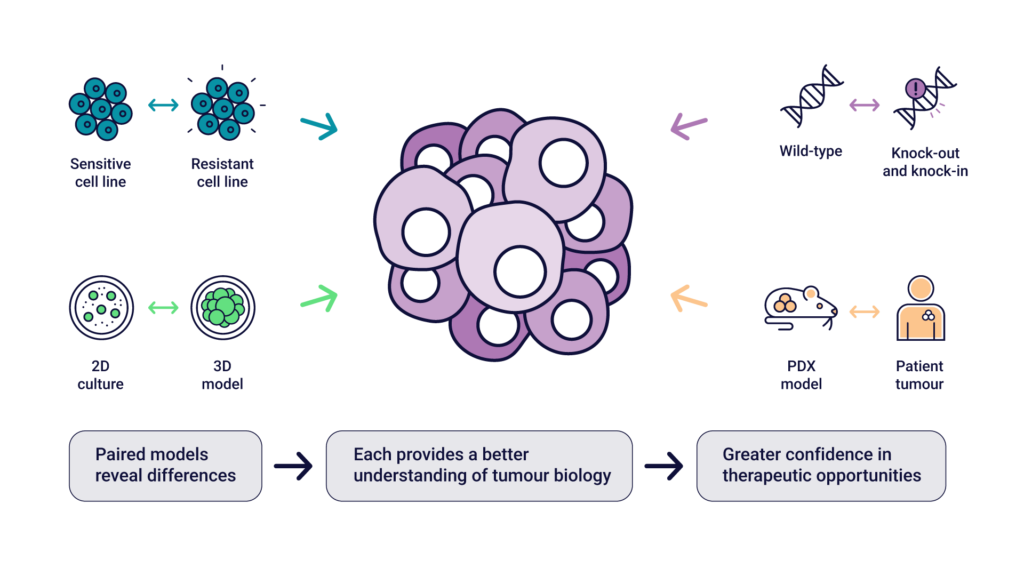
Researchers should understand what question they are asking, what assumptions their model contains and whether their chosen tool is genuinely capable of answering that question. As Allan puts it:
“The choice of model system and control experiments is absolutely critical. Understand what question you are asking each step of the process and critically assess whether the tool or reagent is helping or hindering.”
What also matters is the quality of the tool and where it comes from.
“How stringently has the antibody, cell line, or other compound been assessed? Has it been peer-reviewed? Have other people tried to use it and been able to replicate the same data? Does it inspire confidence? What I care about most is the data that supports its utility.”
The end of “undruggable”
Few phrases have shaped modern drug discovery more than “undruggable”. Historically, targets such as KRAS, MYC and PARG were viewed as inaccessible to traditional small molecule approaches. However, that view is changing.
For Allan, the lesson is clear:
“No target is undruggable. We’re just not clever enough yet, or don’t have the tools and methods, to understand how to do it.”
The rise of degraders, improved antibody-drug conjugates and other novel modalities is opening entirely new ways of thinking about biology and therapeutics. The bigger challenge now lies elsewhere: “I think the biggest challenge we face is disease-relevant target validation.”
Many programmes fail not because the small molecules are ineffective or unsafe, but because the original link between target and disease was incomplete or incorrect. Improving disease-relevant target validation – understanding not simply which biological processes drive disease but also in which patients – may ultimately determine success more than chemistry itself.
More tomorrows
For all the complexity drug discovery brings, Allan always returns to what matters most: patients. Scientists may never meet the people whose lives are changed by their work. Equally, patients may never know the names of the researchers who contributed to their therapy.
For Allan, that recognition has never mattered. “As long as we can change lives, that’s all that matters.”
The PARG story remains particularly meaningful because the original tool compounds have helped catalyse an entire field that now includes numerous companies pursuing clinical development.
“We sit in conferences and see these therapies giving patients extra time that they would not have had otherwise. We were a very, very small part of that. But we were a part of that journey.”
Reflecting on a campaign from his time in Manchester, Allan captures the motivation that underpins so much of biomedical research:
“We’ve given somebody more tomorrows. It doesn’t get better than that.”