Anti-Mast Cell [MCG35]
MCG25 is useful for mast cell identification in immunological reactions and hypersensitivity diseases e.g. allergy and asthma. The antigen is found in granule components of mast cells and may also be found intracytoplasmically in human mature small enterocytes, liver parenchymal cells and kidney proximal tubule epithelial cells.
Contributors
| Inventor | Institute |
|---|---|
| Peter Parker | Queen Mary University of London |
| Cat. #: | 151132 |
|---|---|
| Tool sub type: | Primary antibody |
| Unit size: | 100 ug |
| Research Fields: | Tissue-specific biology |
| Application: | IHC |
| Target: | Mast cell marker |
| Reactivity: | Human |
| Clone: | MCG35 |
| Host: | Mouse |
| Class: | Monoclonal |
| Product description: | MCG25 is useful for mast cell identification in immunological reactions and hypersensitivity diseases e.g. allergy and asthma. The antigen is found in granule components of mast cells and may also be found intracytoplasmically in human mature small enterocytes, liver parenchymal cells and kidney proximal tubule epithelial cells. |
|---|---|
| Conjugation: | Unconjugated |
| Isotype: | IgG1 kappa |
| Molecular weight: | 80 kDa |
| Immunogen: | Spleen cells and bone marrow cells (erythrocyte depleted) from a patient with systemic mastocytosis. The bone marrow preparation consisted of 50% typical mast cells. |
| Myeloma used: | P3X63Ag8.653 |
| Target background: | MCG25 is useful for mast cell identification in immunological reactions and hypersensitivity diseases e.g. allergy and asthma. The antigen is found in granule components of mast cells and may also be found intracytoplasmically in human mature small enterocytes, liver parenchymal cells and kidney proximal tubule epithelial cells. |
|---|
| Format: | Liquid |
|---|---|
| Concentration: | 1 mg/ml |
| Storage buffer: | PBS with 0.02% azide |
| Storage conditions: | -15° C to -25° C |
| Shipping conditions: | Dry ice |
| References: |
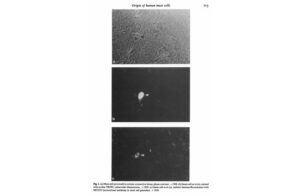
Rimmer et al. 1987. Clin Exp Immunol. 68(3):712-8. PMID: 3308221. Origin of human mast cells studied by dual immunofluorescence. Rimmer et al. 1984. J Clin Pathol. 37(11):1249-55. PMID: 6389604. Human mast cells detected by monoclonal antibodies. |
|---|
Images
View Gallery
Product Images
ce49a21a-c849-454d-9eac-4a911bf584f1
Related Tools for Antibodies
| Cat. # | Tool Name | |||||||||||||||||||||
|---|---|---|---|---|---|---|---|---|---|---|---|---|---|---|---|---|---|---|---|---|---|---|
| 151030 | Anti-Progesterone [11P14] |
Key Info
Anti-Progesterone [11P14]
|
View Tool | |||||||||||||||||||
| 151019 | Anti-Mos [S3.1] |
Key Info
Anti-Mos [S3.1]
|
View Tool | |||||||||||||||||||
| 151033 | Anti-HSVUL42 [13C9] |
Key Info
Anti-HSVUL42 [13C9]
|
View Tool | |||||||||||||||||||
| 151034 | Anti-HSVUL42 [13D11] |
Key Info
Anti-HSVUL42 [13D11]
|
View Tool | |||||||||||||||||||
| 151028 | Anti-Cytochrome P450 2C2, 2B1/2 [h7] |
Key Info
Anti-Cytochrome P450 2C2, 2B1/2 [h7]
|
View Tool | |||||||||||||||||||