Anti-CD3 recombinant antibody [UCH-T1TM]
Recombinant version of CRT trademarked famous anti-CD3 monoclonal antibody, capable of differentiating between T vs B cells lymphomas and leukaemias. Background and Research Application The CD3 complex, composed of four distinct CD3 polypeptide chains ( CD3gamma, CD3omega and 2X CD3episilon), associates with the T cell antigen receptor (TCR). It is found on all mature human […]
Contributors
| Inventor | Institute |
|---|---|
| Peter Beverley | Cancer Research, UK London Research Institute: Lincoln's Inn Fields |
| Cat. #: | 152589 |
|---|---|
| Tool sub type: | Primary antibody |
| Unit size: | 100 ug |
| Research Fields: | Cancer;Cell biology;Cell signaling and signal transduction;Immunology;Stem cell biology |
| Application: | FACS ; WB |
| Target: | CD3 |
| Reactivity: | Human |
| Clone: | rUCH-T1 |
| Host: | Mouse |
| Class: | Recombinant |
| Product description: | Recombinant version of CRT trademarked famous anti-CD3 monoclonal antibody, capable of differentiating between T vs B cells lymphomas and leukaemias. Background and Research Application The CD3 complex, composed of four distinct CD3 polypeptide chains ( CD3gamma, CD3omega and 2X CD3epsilon), associates with the T cell antigen receptor (TCR). It is found on all mature human T lymphocytes, NK cells and some thymocytes. CD3 is a member of the immunoglobulin superfamily, involved in antigen recognition, T lymphocyte activation and signal transduction. This is a recombinant version of anti-CD3 UCH-T1 . UCH-T1 is considered a pan T-cell marker – it can be used for the detection of T cell populations in peripheral blood and lymph nodes and the categorisation of T versus B cell lymphomas and leukaemias. It reacts with the majority of peripheral blood T lymphocytes, a major proportion of thymocytes, the majority of T cell chronic lymphocytic leukaemia cells, Sezary leukaemias and approximately 70% of acute lymphoblastic leukaemias of T cell origin. It can also be used to study the role of CD3 in TCR signal transduction events. This antibody was created by Professor Peter Beverley, a pioneer in creating hybridomas from mice immunised against human lymphocytes, with UCHT1 being one of the first successful fusions. |
|---|---|
| Additional notes: | UCH-T1TM is a registered trademark of Cancer Research Technology, Limited. All rights reserved. |
| Conjugation: | Unconjugated |
| Isotype: | IgG1 |
| Immunogen: | Human infant thymocytes and Sezary cells. |
| Immunogen Uniprot ID: | P04234 |
| Target background: | Recombinant version of CRT trademarked famous anti-CD3 monoclonal antibody, capable of differentiating between T vs B cells lymphomas and leukaemia's.Background and Research Application The CD3 complex, composed of four distinct CD3 polypeptide chains (CD3γ, CD3δ and 2X CD3Ɛ), associates with the T cell antigen receptor (TCR). It is found on all mature human T lymphocytes, NK cells and some thymocytes. CD3 is a member of the immunoglobulin superfamily, involved in antigen recognition, T lymphocyte activation and signal transduction.This is a recombinant version of anti-CD3 UCH-T1. UCH-T1 is considered a pan T-cell marker – it can be used for the detection of T cell populations in peripheral blood and lymph nodes and the categorisation of T versus B cell lymphomas and leukaemia's. It reacts with the majority of peripheral blood T lymphocytes, a major proportion of thymocytes, the majority of T cell chronic lymphocytic leukaemia cells, Szary leukaemia's and approximately 70% of acute lymphoblastic leukaemia's of T cell origin. It can also be used to study the role of CD3 in TCR signal transduction events.This antibody was created by Professor Peter Beverley, a pioneer in creating hybridomas from mice immunised against human lymphocytes, with UCHT1 being one of the first successful fusions. |
|---|
| Format: | Liquid |
|---|---|
| Concentration: | 1 mg/ml |
| Storage buffer: | PBS only |
| Storage conditions: | Store at -20 C frozen. Avoid repeated freeze / thaw cycles |
| Shipping conditions: | Dry ice |
| References: |
Original hybridoma first published in: Beverley et al. 1981. Eur J Immunol. 11(4):329-34. PMID: 6788570. Distinctive Fn characteristics of human "T" lymphocytes defined by E rosetting or a monoclonal anti-T cell antibody. |
|---|
Images
View Gallery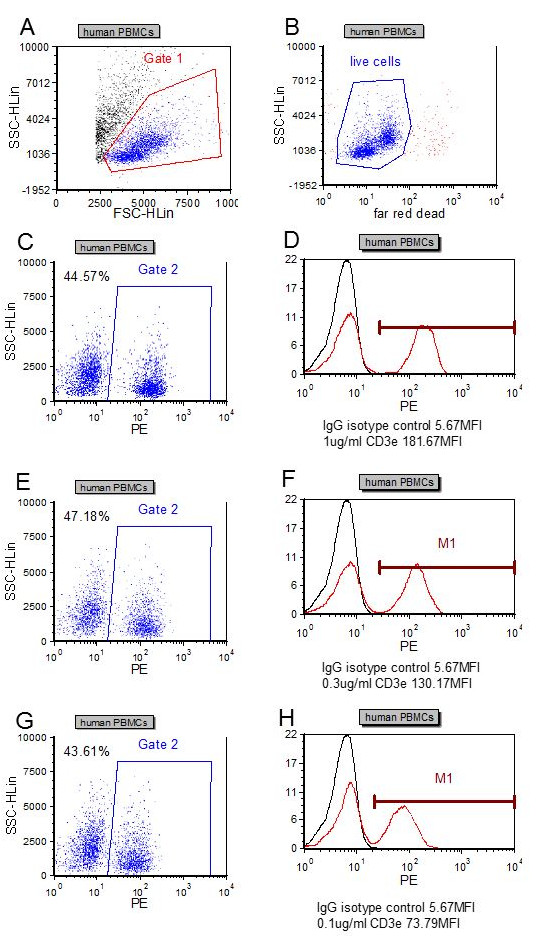
Product Images
c0279675-6c38-4a33-a4d6-b011a19383c6.jpg
Flowcytometric analysis of the dose-dependency (D; F; H) of anti-hCD3e antibody binding to live human PBMCs (B). The gating strategy is shown for control puposes (A; B; C; E; G).
Related Tools for Antibodies
| Cat. # | Tool Name | |||||||||||||||||||||
|---|---|---|---|---|---|---|---|---|---|---|---|---|---|---|---|---|---|---|---|---|---|---|
| 151019 | Anti-Mos [S3.1] |
Key Info
Anti-Mos [S3.1]
|
View Tool | |||||||||||||||||||
| 151023 | Anti-IL12 [1-1D5] |
Key Info
Anti-IL12 [1-1D5]
|
View Tool | |||||||||||||||||||
| 151039 | Anti-Integrin aVb3 [23C6] |
Key Info
Anti-Integrin aVb3 [23C6]
|
View Tool | |||||||||||||||||||
| 151020 | Anti-CyclinB1 [V143.1] |
Key Info
Anti-CyclinB1 [V143.1]
|
View Tool | |||||||||||||||||||
| 151038 | Anti-Cytochrome P450 4A2, 4A3 [Clo4] |
Key Info
Anti-Cytochrome P450 4A2, 4A3 [Clo4]
|
View Tool | |||||||||||||||||||