Anti-Listeria monocytogenes antigen 2 [2:13 C5]
Contributors
| Inventor | Institute |
|---|---|
| Ayham Alnabulsi | Vertebrate Antibodies Limited |
| SKU: | 152799 |
|---|---|
| Product description: | The genus Listeria comprises six species: L. monocytogenes, L. innocua, L. welshimeri, L. seeligeri, L. ivanovii and L. grayi. Listeria monocytogenes, the most commonly isolated pathogenic member, is associated with a wide spectrum of human and animal diseases. In the smear from the original tissue, L. monocytogenes may appear as gram-positive coccobacilli that may be confused with Streptococcus agalactiae (group B), enterococci, or Corynebacterium spp. Listeria is differentiated from streptococci by a positive catalase test. L. monocytogenes is the only species of the genus Listeria that has been clearly documented as a pathogen for humans. The forms of disease caused by this organism are myriad and age-related. The most common clinical manifestations are meningitis and septicemia. Listeria monocytogenes, a food-borne intracellular animal and human pathogen, interacts with infected host cells both prior to entry and during the intracellular phase of infection. |
| Alternate name: | Listeria monocytogenes |
| Conjugation: | Unconjugated |
| Isotype: | IgG1 kappa |
| Molecular weight: | 74 kDa, (faint) 67 kDa, 68 kDa |
| Immunogen: | Listeria monocytogenes antigen 2 protein |
| Myeloma used: | P3X63Ag8.653 |
| Cat. #: | 152799 |
|---|---|
| Unit size: | 100 ug |
| Research Fields: | Microbiology |
| Application: | ELISA ; WB |
| Target: | Listeria monocytogenes antigen 2 protein |
| Reactivity: | L. monocytogenes |
| Clone: | 2:13 C5 |
| Host: | Mouse |
| Class: | Monoclonal |
| Target background: | The genus Listeria comprises six species: L. monocytogenes, L. innocua, L. welshimeri, L. seeligeri, L. ivanovii and L. grayi. Listeria monocytogenes, the most commonly isolated pathogenic member, is associated with a wide spectrum of human and animal diseases. In the smear from the original tissue, L. monocytogenes may appear as gram-positive coccobacilli that may be confused with Streptococcus agalactiae (group B), enterococci, or Corynebacterium spp. Listeria is differentiated from streptococci by a positive catalase test. L. monocytogenes is the only species of the genus Listeria that has been clearly documented as a pathogen for humans. The forms of disease caused by this organism are myriad and age-related. The most common clinical manifestations are meningitis and septicemia. Listeria monocytogenes, a food-borne intracellular animal and human pathogen, interacts with infected host cells both prior to entry and during the intracellular phase of infection. |
|---|
| Format: | Liquid |
|---|---|
| Concentration: | 1 mg/ml |
| Storage buffer: | PBS with 0.02% azide |
| Storage conditions: | -15° C to -25° C |
| Shipping conditions: | Dry ice |
Images
View Gallery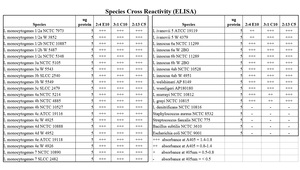
Product Images
3cfb7244-d130-4e47-ba82-25f7e3a8ced1
146ff415-7354-42cb-a310-e065aeb00a52.jpg
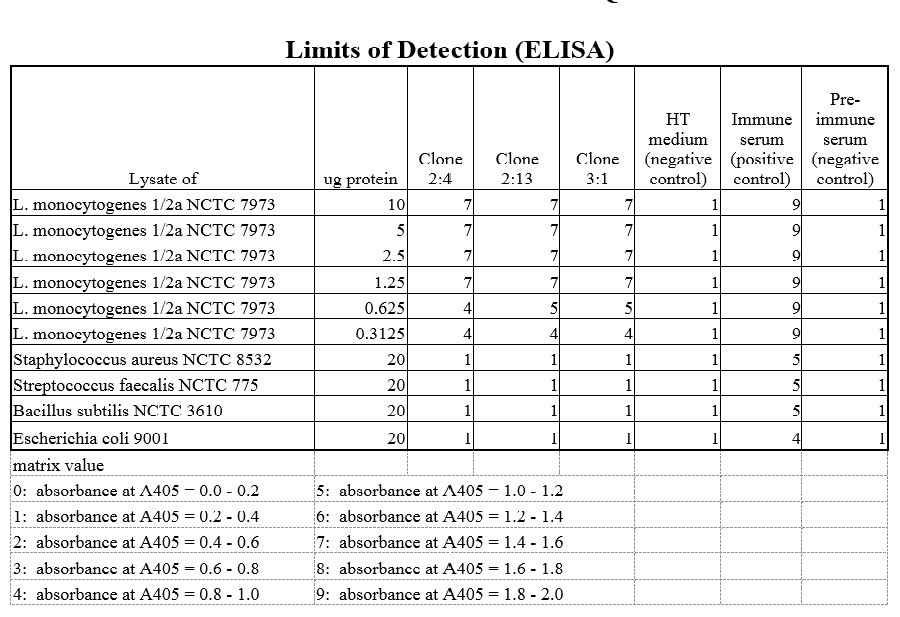
ELISA detection showing the sensitivity and specificity of anti-Listeria monocytogenes antigen 2 [2