Holiday shipping dates:
Last international orders dispatched: Friday 11th December
Last UK domestic orders dispatched: Wednesday 16th December
Following the holiday period, shipping will resume as normal from the week commencing Monday 4th January 2027
Anti-MDM2 [SMP14]
Exclusive toolMDM2 is over-expressed in many tumours. Its principal function is the ubiquitination and degradation of p53 tumour suppressor protein.
Contributors
| Inventor | Institute |
|---|---|
| David Lane | University of Dundee |
| SKU: | 151295 |
|---|---|
| Product description: | MDM2 is over-expressed in many tumours. Its principal function is the ubiquitination and degradation of p53 tumour suppressor protein. |
| Conjugation: | Unconjugated |
| Isotype: | Ig3 Kappa |
| Immunogen: | Synthetic peptide CSRPSTSSRRRAISE (residues 154-167 in human MDM2) cross-linked to KLH using glutaldehyde. |
| Myeloma used: | P3X63Ag8.653 |
| Cat. #: | 151295 |
|---|---|
| Provenance and Ownership: | The Anti-MDM2 [SMP14] is owned by Cancer Research UK. CancerTools supplies the Anti-MDM2 [SMP14] under licence from Cancer Research UK and is the authorised source for its distribution. Sourcing Anti-MDM2 [SMP14] directly from the IP owner ensures authenticity, provenance and compliance with all applicable licensing and research use requirements. |
| Tool sub type: | Primary antibody |
| Unit size: | 100 ug |
| Application: | ELISA ; IHC ; IF ; IP ; WB |
| Target: | Murine Double Minute 2 protein (MDM2) |
| Reactivity: | Human |
| Clone: | SMP 14 |
| Host: | Mouse |
| Class: | Monoclonal |
| Target background: | MDM2 is over-expressed in many tumours. Its principal function is the ubiquitination and degradation of p53 tumour suppressor protein. |
|---|
| Format: | Liquid |
|---|---|
| Concentration: | 1 mg/ml |
| Storage buffer: | PBS with 0.02% azide |
| Storage conditions: | -15° C to -25° C |
| Shipping conditions: | Dry ice |
| References: |
Tao et al. 2013. Cell Res. 23(5):620-34. PMID: 23357851. Jiang et al. 2013. Nature. 493(7434):689-93. PMID: 23334421. Def defines a conserved nucleolar pathway that leads p53 to proteasome-independent degradation. Reciprocal regulation of p53 and malic enzymes modulates metabolism and senescence. Das et al. 2007. Int J Surg Pathol. 15(4):335-45. PMID: 17913939. p53 and mdm2 expression in colorectal carcinoma: a correlative analysis with clinical staging and histological parameters. Hashemi et al. 2002. Cancer Lett. 180(2):211-21. PMID: 12175554. A melanoma-predisposing germline CDKN2A mutation with Fn significance for both p16 and p14ARF. Zhang et al. 2001. J Biol Chem. 276(32):29702-10. PMID: 11359766. Cyclin a-CDK phosphorylation regulates MDM2 protein interactions. Bttger et al. 1997. J Mol Biol. 269(5):744-56. PMID: 9223638. Molecular characterization of the hdm2-p53 interaction. Dowell et al. 1996. Cytopathology. 7(5):340-51. PMID: 8911758. Expression of p21waf1/Cip1, MDM2 and p53 in vivo: analysis of cytological preparations. Picksley et al. 1994. Oncogene. 9(9):2523-9. PMID: 8058315. Immunochemical analysis of the interaction of p53 with MDM2 –fine mapping of the MDM2 binding site on p53 using synthetic peptides. |
|---|
Images
View Gallery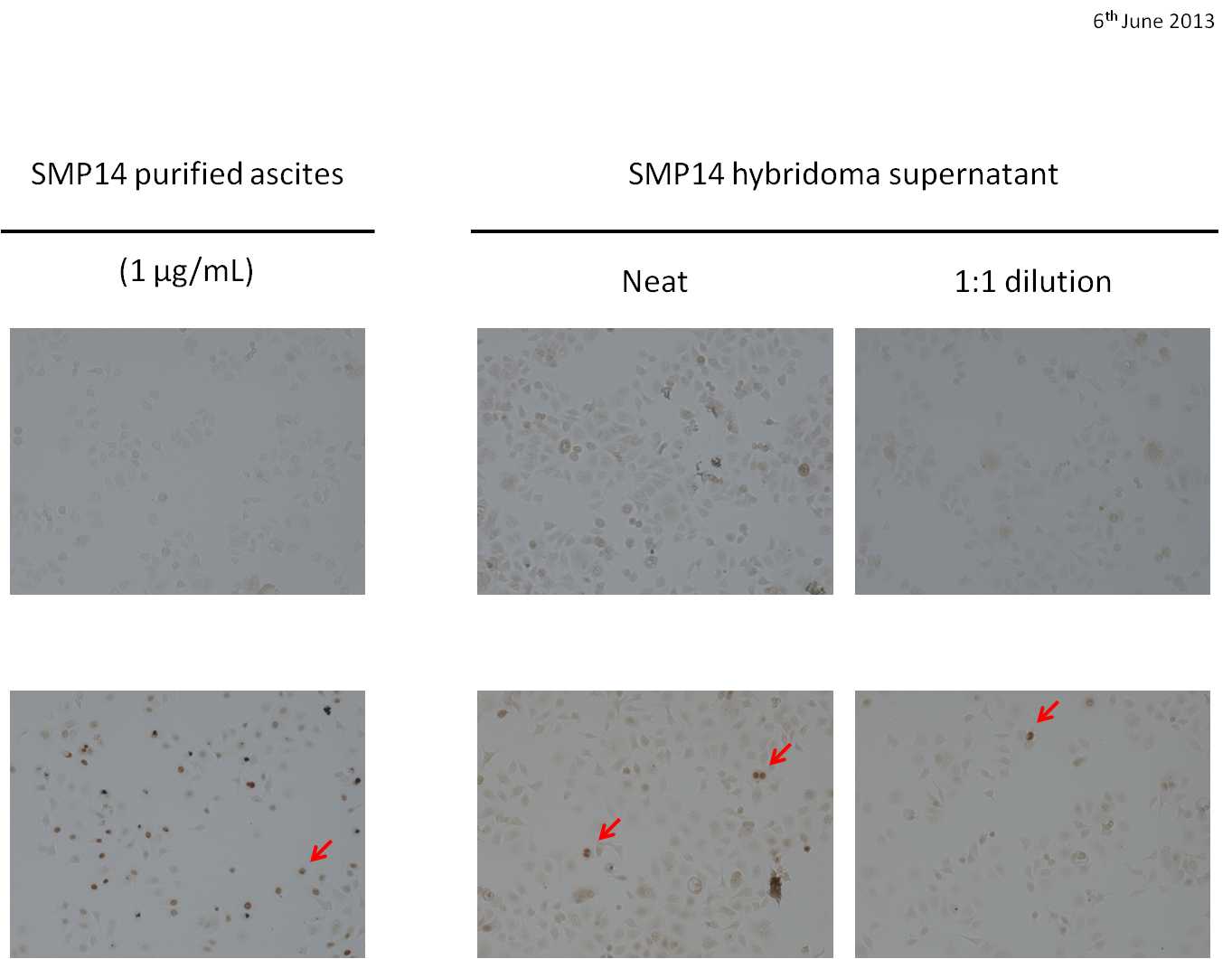
Product Images
92844519-9935-4e65-bd9f-7890be4f5333.png
Cell staining with SMP14 hybridoma supernatant of MCF7 treated with Nutlin